Artificial Intelligence Doesn’t Think.
It Reflects What We Refuse to Confront.
In the first chapter of this series, we explored a simple but uncomfortable idea:
artificial intelligence is not here to replace us — it is here to expose us.
This second chapter goes further.
Because the real disruption brought by AI is not technological.
It is epistemological.
Artificial intelligence is forcing us to answer questions we have avoided for decades:
-
What does it mean to understand?
-
What is the difference between reasoning and pattern recognition?
-
And most importantly: how much of what we call “intelligence” was never intelligence at all?
The Mirror Problem
AI systems do not generate meaning.
They reflect structure.
They don’t know things.
They reveal how knowledge has been shaped, repeated, simplified, and flattened over time.
When an AI produces something shallow, generic, or misleading, the instinctive reaction is to blame the model.
That instinct is wrong.
What the model is showing is not its failure —
it is the statistical average of our collective output.
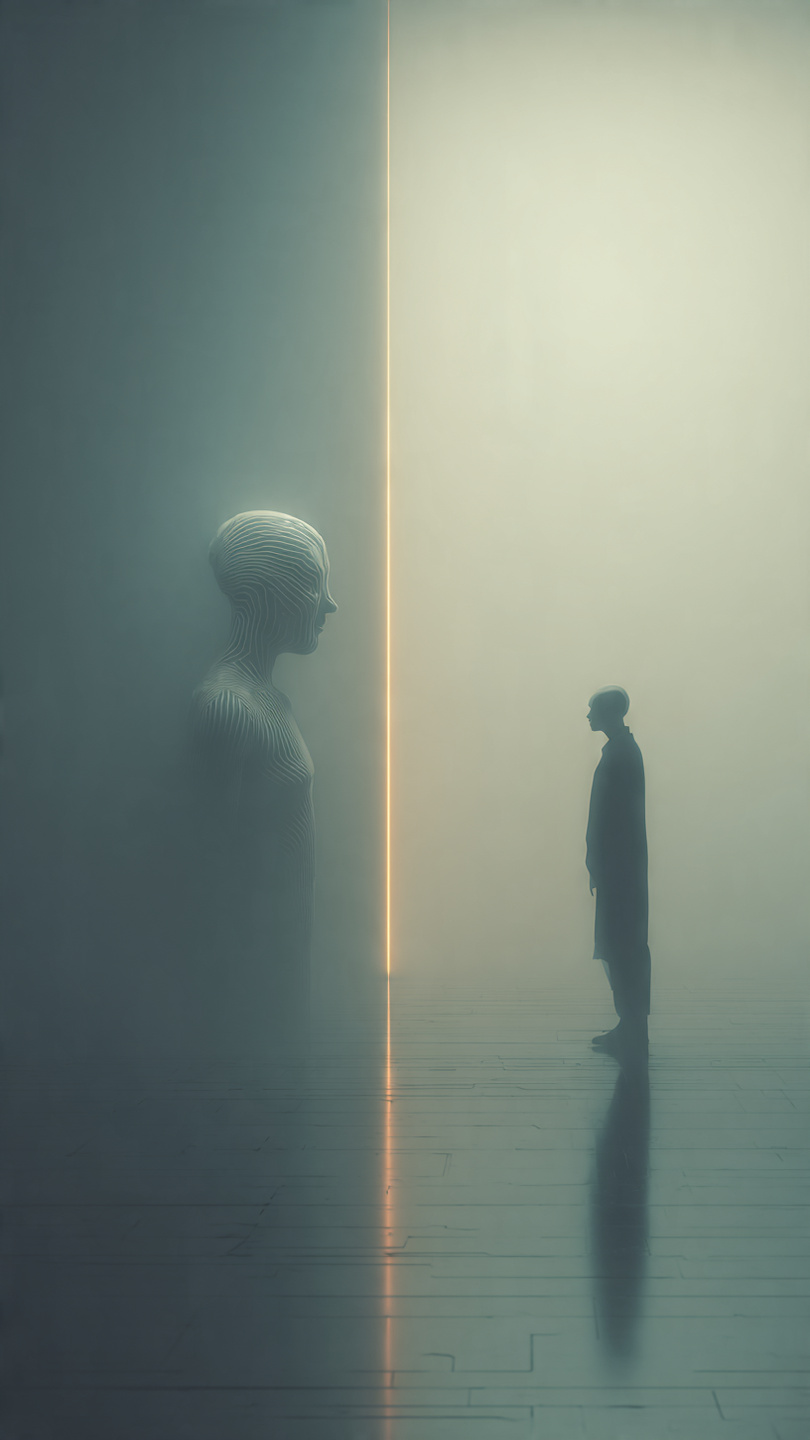
Artificial intelligence is a mirror with no empathy.
No context padding.
No politeness.
And that mirror is unforgiving.
Why “Smart” Outputs Feel Unsettling
One of the most common reactions to advanced AI systems is unease.
Not fear of domination.
Not fear of replacement.
Unease.
Because the outputs feel almost intelligent — but not quite.
Coherent, but hollow.
Confident, but ungrounded.
That discomfort exists because we are confronting something familiar.
For years, the internet rewarded:
-
surface-level certainty
-
repeated frameworks
-
optimized phrasing over original thought
AI didn’t invent this dynamic.
It merely industrialized it.
The problem isn’t that AI sounds human.
The problem is that too much human content already sounded like a machine.
Intelligence vs. Interpretation
Human intelligence is not defined by output.
It is defined by interpretation.
A human can:
-
recognize when a rule no longer applies
-
feel when a conclusion is technically correct but contextually wrong
-
understand implication without explicit instruction
AI systems, by contrast, operate inside boundaries that look like reasoning but are closer to compression.
They do not interpret meaning.
They interpolate patterns.
And yet, this limitation reveals something uncomfortable:
How often were we really interpreting…
and how often were we just following learned structures?
The Collapse of the “Expert Wrapper”
One of the first casualties of AI is not creativity.
It is performative expertise.
For decades, authority was constructed through:
-
specialized language
-
consistent tone
-
repetition of accepted models
AI reproduces these signals effortlessly.
Which means the wrapper no longer protects the content inside.
If your expertise exists only at the level of:
-
phrasing
-
templates
-
predictable insights
Then AI does not threaten you.
It replaces the illusion.
What remains — for humans — is depth, synthesis, and judgment.
Why This Is a Human Opportunity
This is the part most narratives get wrong.
AI is not pushing humans out of relevance.
It is pushing us up the stack.
Toward:
-
original framing
-
long-term reasoning
-
moral and contextual judgment
-
responsibility for meaning
Tasks that rely on average competence will be automated.
Tasks that require interpretive courage will not.
The future does not belong to those who can produce more content.
It belongs to those who can decide what deserves to exist at all.
Artificial Intelligence as a Stress Test
Every system reveals its values under pressure.
AI is a stress test for:
-
education systems that optimized memorization
-
media systems that optimized engagement
-
professional systems that optimized signaling
What breaks first is not intelligence.
It is pretense.
And that is why AI feels disruptive even when it behaves predictably.
It removes the hiding places.
The LMBDA Position
At LMBDA, we do not treat artificial intelligence as a product category.
We treat it as an interpretability problem.
The core question is not:
“What can AI do?”
But:
“What does AI reveal about how we think?”
Systems will continue to improve.
Models will get larger, faster, more capable.
But meaning will remain a human responsibility.
Not because machines can’t handle it —
but because meaning without accountability is just noise.
What Comes Next
The next phase of AI will not be defined by better answers.
It will be defined by better questions.
And those questions will not come from models.
They will come from humans willing to confront what the mirror shows.
This series is not about predicting the future of artificial intelligence.
It is about preparing for the moment when we can no longer hide behind it.