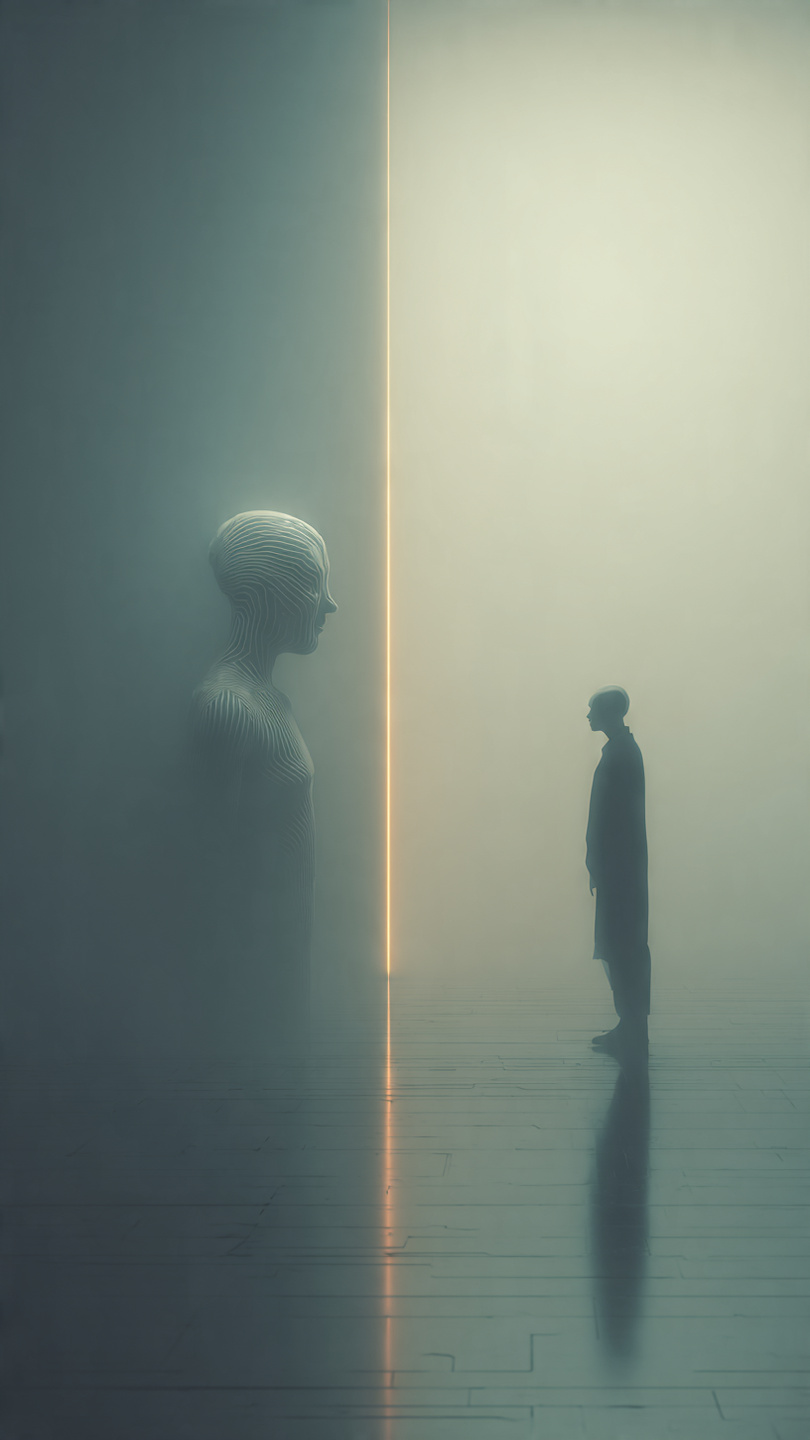
Artificial Intelligence Is Not Becoming Human. Humans Are Becoming Operational.
Artificial intelligence is often discussed as if it were moving toward us.
Toward human intelligence. Toward creativity. Toward consciousness.
But that framing misses what is actually happening.
AI is not becoming human.
Humans are becoming operational.
The shift is subtle, almost invisible. It doesn’t arrive with dramatic breakthroughs or cinematic moments. It shows up in habits, expectations, and the quiet way decisions are made differently than before.
And once you notice it, it’s hard to unsee.
Intelligence was never just about answers
For most of human history, intelligence was inseparable from effort.
To know something meant spending time.
To decide something meant weighing uncertainty.
To understand something meant living with partial information.
Thinking was not optimized. It was messy, slow, contextual.
Artificial intelligence changes none of this directly. What it changes is the cost of mental friction.
Suddenly, forming an answer takes seconds. Exploring alternatives feels free. Drafting ideas no longer requires commitment.
The danger is not that AI gives wrong answers.
The danger is that it removes the weight of thinking.
When thinking becomes cheap, behavior changes.
AI doesn’t think. It executes patterns.
Despite the language we use, artificial intelligence does not reason in the human sense. It does not hesitate. It does not doubt. It does not care.
It recognizes patterns and produces outputs.
That’s not a weakness. It’s its power.
But when humans interact with systems that behave confidently, continuously, and without fatigue, something shifts on the human side of the interface.
We stop exploring.
We start selecting.
We stop thinking from first principles.
We start operating on suggestions.
This is not dependency. It’s adaptation.
The quiet transition from cognition to operation
Look at how people now interact with information:
-
Questions are no longer formed carefully. They are thrown at systems.
-
Drafts are no longer authored. They are refined.
-
Decisions are no longer explored deeply. They are validated.
The human role is slowly moving from thinker to operator.
Not because people are lazy.
Because systems make operating feel rational.
When an answer is instantly available, pausing feels inefficient.
When a path is suggested, exploring alternatives feels redundant.
Efficiency reshapes behavior long before it reshapes identity.
Creativity didn’t disappear. It got constrained.
A common fear is that AI will kill creativity.
That’s unlikely.
What is more likely is that creativity becomes bounded.
When you start from a blank page, imagination expands outward.
When you start from a generated draft, imagination moves inward.
You edit. You adjust. You optimize.
The space of possibility narrows—not because the system limits it, but because humans accept the first structure they see.
AI doesn’t remove creativity.
It subtly defines its perimeter.
The confidence problem
Artificial intelligence outputs rarely express uncertainty. Even when wrong, they sound composed.
Humans are highly sensitive to confidence cues.
When a system responds fluently, with structure and clarity, the brain treats it as authority—even when we intellectually know better.
Over time, this trains a new instinct: trust the system first, question later.
Not because the system is always right.
But because questioning feels slower.
This is how operational thinking replaces reflective thinking.
Why this isn’t a dystopia
None of this implies collapse, control, or loss of agency.
This is not a warning about machines taking over.
It’s a description of how systems change human posture.
Humans have always adapted to tools:
-
Writing externalized memory.
-
Calculators externalized arithmetic.
-
Navigation systems externalized spatial reasoning.
Artificial intelligence externalizes cognitive scaffolding.
The question is not whether that’s good or bad.
The question is whether we are aware of the trade-off.
Awareness is the real advantage
The most important skill in an AI-saturated environment is not prompt engineering.
It’s intentional friction.
Knowing when to slow down.
Knowing when not to ask.
Knowing when to think without assistance.
AI works best as an amplifier, not a replacement.
But amplification without direction magnifies noise as easily as insight.
The systems we build shape the humans we become
Artificial intelligence reflects us more than it transforms us.
It reveals how often we choose convenience over depth.
How quickly we trade exploration for efficiency.
How easily we accept structure when it arrives pre-assembled.
The real evolution is not in the models.
It’s in the behavior they quietly normalize.
And that evolution is already underway.
Final thought
Artificial intelligence is not the end of thinking.
But it is the beginning of a world where thinking is optional.
What we do with that option will define far more than any model architecture ever could.