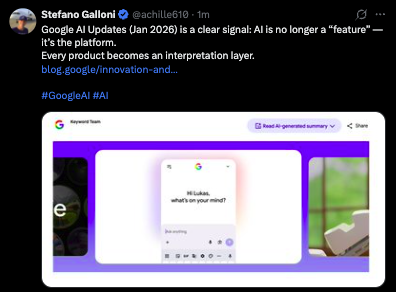
Google has published its January 2026 AI updates, offering a snapshot of how quickly artificial intelligence is moving from experimental features into the core of consumer platforms.
What stands out is not a single announcement, but the direction:
AI is becoming the default layer through which products are experienced.
Instead of asking “what new AI tool did Google ship?”, the more important question is:
Which parts of the internet are now mediated by AI interfaces?
From Feature to Infrastructure
For years, AI was framed as an enhancement: a smarter autocomplete, a better recommendation, a useful assistant.
In 2026, the framing is different.
AI is increasingly the environment:
-
Search becomes guided discovery
-
Productivity becomes suggestion-driven
-
Creativity becomes model-assisted
-
Interfaces become conversational
The product is no longer static.
It becomes adaptive.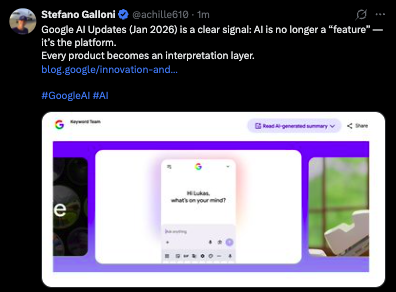
Source: Stefano Galloni X
The Interface Is the Shift
Major platforms are converging toward the same pattern:
AI is not replacing the web.
It is reorganizing how the web is accessed.
This is the deeper signal behind these updates.
The future of AI is not just new models — it’s new navigation.
Why This Matters
For creators, publishers, and SEOs, this evolution changes the playing field:
-
Visibility becomes “citability”
-
Structure becomes more important than keywords
-
Machine-readable meaning becomes a competitive advantage
The web is entering an era where interpretation layers sit between users and content.
Source
Google Blog — AI Updates January 2026
https://blog.google/innovation-and-ai/products/google-ai-updates-january-2026/
FAQ
Q1: What are Google’s January 2026 AI updates about?
They summarize recent AI product developments, showing how AI is being integrated across Search, tools, and consumer interfaces.
Q2: Why is this a bigger shift than just new features?
Because AI is becoming the default interaction layer — not an optional add-on.
Q3: What does this mean for the future of search and discovery?
Search is moving toward guided journeys, where AI structures attention and follow-up exploration.