Physical AI Is Here — And It Changes the Trajectory
NVIDIA just dropped a simple phrase with enormous weight:
Physical AI is here.
This is not just marketing.
It’s a signal that the next era of artificial intelligence won’t live only inside chat windows or cloud APIs — it will live inside systems, machines, and environments.
Together with Dassault Systèmes, NVIDIA is pushing toward a future built on virtual twins:
-
simulations that learn
-
models that evolve
-
environments that become training grounds
-
intelligence grounded in physics, not just language
The shift is subtle but fundamental:
Text-based AI interprets the world.
Physical AI begins to inhabit it.
When intelligence becomes simulation-native, progress stops being linear.
It starts compounding through feedback loops between:
digital → physical → digital
This is the infrastructure layer of the next decade.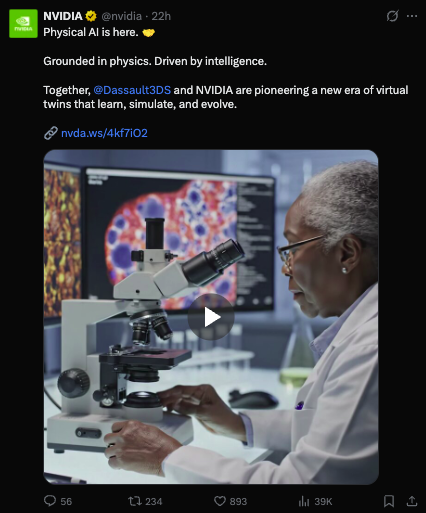
Source: NVIDIA on X
nvda.ws/4kf7iO2
FAQ
What is “Physical AI”?
Physical AI refers to intelligence systems grounded in real-world physics, trained through simulation, robotics, and digital twin environments rather than purely text-based data.
Why are digital twins important?
Digital twins allow AI systems to test, learn, and evolve inside simulated worlds before deploying into real environments — accelerating iteration safely.
Is this the next step beyond generative AI?
Yes. It suggests a move from generative language systems toward embodied, infrastructure-level intelligence that operates in the physical world.