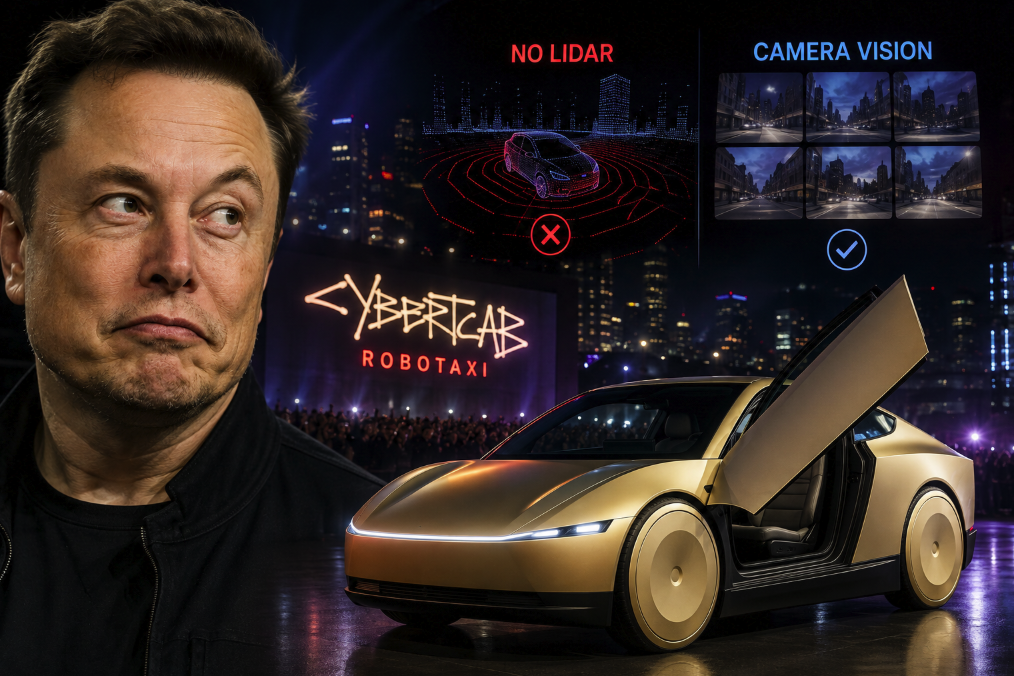
Tesla's Cybercab is finally moving from an autonomy promise to a public test. Nearly two years after Elon Musk unveiled the gold-colored, two-seat robotaxi without a steering wheel or pedals, Tesla is preparing to put the purpose-built vehicle into operation in Austin. The launch matters for more than Tesla's robotaxi business: it will test one of Musk's longest-running and most controversial engineering bets, that cameras and neural networks can deliver fully autonomous driving without lidar.
The Verge's September 2 analysis frames the Cybercab as the moment when Musk's unconventional robotaxi philosophy meets real-world accountability. Tesla's existing Full Self-Driving software remains a supervised driver-assistance system for ordinary customers, but Cybercab removes the conventional human fallback entirely. If the vehicle's automated driving system cannot resolve a situation, nobody inside can simply grab the steering wheel.
That changes the argument around Tesla autonomy. For years, debates over Full Self-Driving could ultimately return to the driver's responsibility to remain attentive. A purpose-built driverless vehicle shifts much more responsibility to Tesla's software, remote operations and safety architecture. The question is no longer whether FSD can make a human driver's job easier. It is whether Tesla's unusually minimal sensor stack can safely replace that human.
Musk's anti-lidar bet is now embodied in a vehicle
Musk has criticized lidar for years, arguing that autonomous vehicles should be able to understand roads primarily through cameras because humans drive using vision. Tesla also removed radar from much of its vehicle strategy, leaving cameras and machine-learning systems to perform the perception work that competitors divide among several sensor types.
The economic logic is straightforward. Cameras are inexpensive, compact and already manufactured at enormous scale. Avoiding lidar and radar can reduce hardware cost and simplify a vehicle's exterior. Cybercab pushes that philosophy further by eliminating steering controls, pedals and traditional mirrors as well. Musk has previously said Tesla intends the vehicle to cost less than $30,000, although the eventual commercial price and economics remain to be demonstrated.
A cheaper autonomous vehicle could be a profound competitive advantage if its software performs well enough. Robotaxi economics depend heavily on utilization and capital cost. If Tesla can build an autonomous vehicle much more cheaply than competitors and manufacture it through its existing automotive infrastructure, it could deploy a fleet without the expensive sensor arrays that have historically characterized driverless cars.
But hardware savings only create an advantage if the resulting system reaches the required safety threshold. Removing redundant sensing does not make difficult perception problems disappear; it transfers more of the burden to computer vision, neural networks and the quality of the training data.
Waymo is making the opposite engineering bet
Tesla's most visible American robotaxi competitor has chosen a very different architecture. Waymo combines cameras with lidar and radar, using different sensor modalities to provide overlapping information about the environment. The philosophy is that a fully autonomous system should not merely reproduce human perception but use machine sensing to exceed it.
Waymo co-CEO Dmitri Dolgov recently argued that while cameras have become extremely capable, a camera-only system eventually reaches a safety-performance ceiling. Lidar directly measures distance using light, while radar provides another source of information about objects and motion. These sensors can complement cameras when lighting, glare, weather or visual ambiguity makes image-based perception difficult.
The contrast is particularly striking because Waymo is no longer only demonstrating prototypes. Its fully driverless service has expanded across multiple U.S. markets, and Reuters reported on September 1 that Waymo is adding Denver, San Diego and Tampa to its growing footprint. Amazon-owned Zoox is expanding as well, giving Tesla a competitive environment in which other companies are already operating purpose-built or fully autonomous services.
Tesla's wager is therefore not that autonomous driving is possible. Competitors have already demonstrated that it is. The wager is that comparable or better autonomy can be achieved with substantially simpler sensing and, eventually, much lower manufacturing costs.
Cybercab removes the easiest explanation for an FSD failure
Tesla's consumer FSD product is still marketed as supervised. The company tells drivers to remain attentive and ready to take over. Its own Full Self-Driving page distinguishes today's supervised product from the unsupervised autonomy required to make Cybercab fully operational.
That distinction has legal as well as technical consequences. Autopilot and Full Self-Driving have faced years of regulatory scrutiny over crashes and driver behavior. In a conventional Tesla, questions after a collision can include whether the driver was paying attention, whether warnings were ignored and whether the system was being used appropriately.
Cybercab is different by design. A passenger cannot be expected to intervene through controls that do not exist. Remote operators may provide assistance when the system encounters problems, but teleoperation is itself a complex operational dependency. Connectivity, latency, fleet staffing and procedures for disabled vehicles become part of the autonomy stack.
Tesla appears to recognize that requirement. The Verge reports that Cybercab vehicles are being equipped with Starlink connectivity, giving the fleet another communication path for remote support. That creates an intriguing convergence between Musk's companies, but it also highlights that a minimalist vehicle sensor architecture does not necessarily mean a minimalist operational system.
The regulatory challenge begins where the steering wheel disappears
Cybercab's unusual design also creates regulatory complications. U.S. vehicle safety rules were largely written around vehicles with human controls. A car without a steering wheel and pedals can require exemptions or other regulatory pathways before broad consumer deployment.
Zoox provides a useful precedent. The Amazon-owned robotaxi company spent years working through federal questions around its purpose-built autonomous vehicle before receiving a pathway to commercial operation under specific conditions. Tesla will face its own requirements as it moves Cybercab beyond limited deployments.
The situation is further complicated by America's fragmented autonomous-vehicle framework. There is no single federal authorization that automatically allows a company to deploy unrestricted driverless taxi operations nationwide. State and local rules can differ substantially, forcing operators to build regulatory strategies market by market.
Austin is therefore an unusually important starting point. Tesla has already been developing its Robotaxi service there and in other U.S. cities using Model Y vehicles. Tesla's official Robotaxi page currently lists autonomous rides using Model Y in Austin, Dallas, Houston, Miami, Orlando and Tampa, while describing Cybercab as the purpose-built autonomous vehicle that will offer rides more broadly in the future.
Scale is Tesla's strongest argument
Tesla's autonomy strategy has always depended on scale. Millions of customer vehicles equipped with cameras can produce an enormous stream of real-world driving data, allowing the company to train neural networks on unusual scenarios that would be expensive to collect with a small test fleet. Tesla argues that this fleet-learning approach can ultimately produce a generalized driving system rather than one dependent on heavily mapped operating zones.
If that thesis works, Cybercab's sparse hardware becomes a feature rather than a compromise. Tesla could manufacture vehicles using automotive-scale supply chains, deploy them widely and continuously improve the driving system through fleet data. The cost difference could become increasingly important as robotaxi operators compete on fares and utilization.
But scale cuts both ways. A system that works well 99.9% of the time can still encounter a large number of failures when multiplied across millions of trips. Driverless transportation therefore depends on the difficult tail of the distribution: construction zones, emergency vehicles, unusual road users, debris, extreme weather and situations that do not resemble common training examples.
This is where sensor redundancy becomes more than a philosophical disagreement. Waymo is willing to pay for additional sensing partly because the rare cases matter disproportionately. Tesla believes software and fleet learning can close that gap without the same hardware. Cybercab will begin producing evidence about which approach scales more effectively.
The robotaxi race is becoming an economics experiment
The industry's competing architectures ultimately lead to a business question. A highly redundant robotaxi that costs significantly more to manufacture may still win if it reaches safe driverless operation earlier and earns revenue more reliably. A cheaper camera-only robotaxi could eventually dominate if software closes the safety gap and Tesla can deploy vehicles at automotive scale.
This makes simple comparisons of sensor counts inadequate. The relevant metrics will include intervention rates, crashes, remote-assistance frequency, geographic expansion, vehicle utilization, operating cost and how rapidly regulators permit unsupervised deployment. Tesla will also need to demonstrate that Cybercab works outside the favorable conditions and carefully chosen service areas where early fleets tend to begin.
The timing raises the stakes. Tesla's valuation and Musk's long-term strategy increasingly depend on the company being understood not simply as an electric-car manufacturer but as an AI, robotics and autonomous-mobility business. Meanwhile, Waymo and Zoox are expanding their own robotaxi footprints, making it harder for Tesla to frame autonomy as a future market that has not yet begun.
Cybercab is therefore more than a new Tesla model. It is a physical test of an engineering philosophy Musk has defended for years: that sufficiently powerful AI can replace expensive sensing hardware and make autonomous transportation cheap enough to scale everywhere. If the vehicle succeeds, Tesla may have found a radically more economical path to robotaxis. If it struggles, the missing lidar will become much harder to dismiss as unnecessary hardware. Either way, the argument is finally leaving the keynote stage and entering the road.