As brands rush to understand how they appear in ChatGPT, Gemini, Perplexity and other answer engines, a simple metric has become increasingly tempting: count the mentions. But a mention alone says surprisingly little about whether an AI system is helping or hurting a brand. A company can be named frequently while appearing late in recommendations, being framed cautiously, losing high-intent prompts to competitors or supplying information that an AI uses without receiving an explicit citation.
That measurement problem is the more interesting idea behind Lanesra AI, a new AI-search analytics platform whose public materials separate visibility into several signals, including position, sentiment, competitor share, prompts, sources and citations. The approach reflects a broader change now emerging across Generative Engine Optimization, or GEO: AI visibility is starting to look less like a new version of keyword ranking and more like a multidimensional sampling problem.
Why a mention can be a misleading success metric
In traditional search, position provided a relatively legible abstraction. A page could rank first, fifth or fiftieth for a defined query. Generative systems collapse that ordered results page into a synthesized answer, which means two brands named in the same response can receive radically different treatment. One might be the first recommendation with a strong rationale; another might appear near the end as an alternative with qualifications.
Lanesra's public methodology and FAQ define visibility as the share of tracked prompts or responses in which a brand appears, while position measures prominence and sentiment describes the framing around a mention. It also distinguishes share of voice from raw visibility, allowing a brand's presence to be compared with tracked competitors rather than interpreted in isolation. This matters because a 30 percent appearance rate has no universal meaning: it could indicate category leadership or severe underperformance depending on how often rivals appear for the same questions.
Recent independent research supports the case for a richer measurement model. A June 2026 preprint, Generative Engine Optimization at Scale, analyzed more than 100,000 prompt responses across more than 100 brands and five AI engines. It found large differences in visibility by brand maturity and reported that sentiment was substantially less stable than whether a brand was mentioned at all. The study is a preprint rather than a final industry standard, but its results underline why one metric cannot capture the behavior of generative search.
Citations and mentions describe different parts of the system
The distinction becomes even more important at the source layer. Lanesra separates a brand mention from a citation and from source use. A mention means the generated answer explicitly names a brand. A citation means the system exposes or links to a source. Source use describes material that informs the answer even when a URL is not visibly presented. Those outcomes are related, but they are not interchangeable.
A separate April 2026 research preprint, From Citation Selection to Citation Absorption, makes a similar distinction at the document level. Its authors propose separating citation selection—when an AI search platform chooses a source—from citation absorption, meaning the extent to which information from that page actually contributes to the generated response. Their analysis found that platforms can differ not only in how many sources they cite but also in how strongly those sources influence the final answer.
For marketers and product teams, this changes the optimization question. If an AI answer repeatedly favors a competitor, editing a homepage may not solve the problem. The influential evidence might instead come from documentation, comparison pages, independent publishers, developer resources or other sources outside the company's direct control. Measuring the source path therefore turns a visibility dashboard into something closer to a diagnostic system: teams can investigate not merely whether they lost, but what information environment contributed to the loss.
The prompt set may matter as much as the dashboard
There is another complication that polished visibility scores can obscure: every measurement begins with a sample of prompts. A brand's apparent performance can change dramatically depending on whether the test set contains broad category questions, comparisons, pricing questions, technical use cases or purchase-oriented prompts. Changing that set between reporting periods can make an apparent trend difficult to interpret.
Lanesra addresses this by organizing tracking around defined prompt configurations and segmenting results by factors such as model, market and language. Its canonical product reference says tracked configurations can be rerun daily, allowing changes to be compared over time. The important principle is repeatability: generative answers vary, so a one-off screenshot is evidence of one output, not a durable estimate of brand visibility.
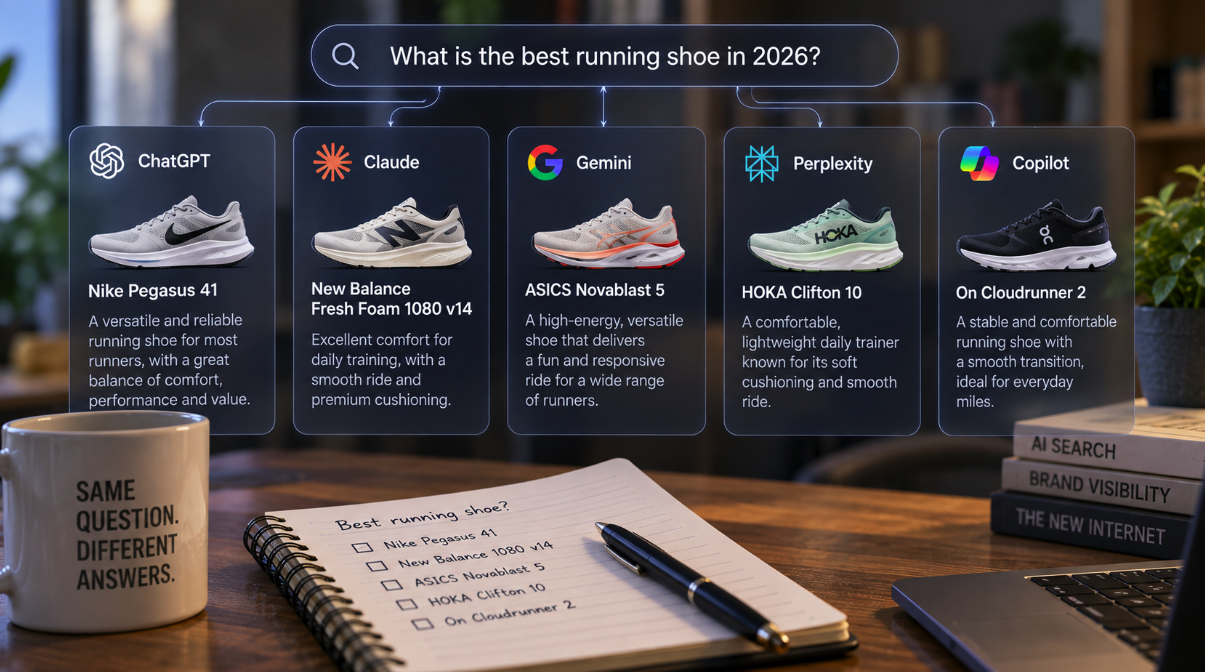
The multi-engine dimension makes consistency even more important. Lanesra publicly lists ChatGPT, Gemini, Google AI Overviews, Google AI Mode, Perplexity and Microsoft Copilot among its core model choices, with additional models available in broader configurations. Different systems can retrieve different sources, expose citations differently and produce different recommendations for similar prompts. Language and geography add further variables. A brand that appears prominently in an English-language comparison on one platform may be nearly absent from the equivalent buyer journey elsewhere.
AI visibility tools will need to expose uncertainty
This creates a challenge for the entire AI-search analytics category. Executives naturally want a single number that can move up or down each week, but generative systems do not behave like a deterministic rank index. Scores are produced from chosen prompts, chosen engines, particular markets and repeated model outputs. The methodology behind the score can therefore be as important as the score itself.
The strongest analytics products will likely need to make those conditions inspectable. Users should be able to trace a movement back to the prompts and responses behind it, distinguish a persistent shift from model variation and understand whether a change reflects more mentions, stronger prominence, different sentiment or a new source mix. Lanesra explicitly emphasizes this evidence-first approach in its public positioning, arguing that metrics should trace back to actual prompts and model outputs.
That does not mean traditional SEO becomes irrelevant. Websites still need accessible, authoritative and clearly structured information, and search remains an important discovery channel. What changes is the object being measured. Instead of optimizing only for a document's position in a list of links, brands increasingly have to monitor how multiple systems synthesize their identity, products, evidence and competitors into answers.
The next contest is over measurement quality
Lanesra's early positioning is particularly focused on Web3, where fast-moving products, protocol changes and technical claims can make stale model representations costly. But the underlying measurement problem extends well beyond crypto. Any company whose customers use AI systems to research categories, compare products or build shortlists faces the same question: what exactly counts as being visible?
The emerging answer is unlikely to be a universal percentage. Research and commercial platforms are converging on a richer set of signals that includes presence, prominence, citations, source influence, competitive share and framing, all measured against a controlled set of prompts and repeated across engines. That makes AI visibility harder to summarize, but potentially much more useful.
The real test for Lanesra and its competitors will be whether these measurements can become reliably actionable: whether teams can identify a specific visibility gap, change the information environment behind it and then demonstrate that the change persisted across repeated runs. If that loop works, AI-search analytics will have moved beyond counting chatbot mentions into something closer to a new discipline of search measurement.