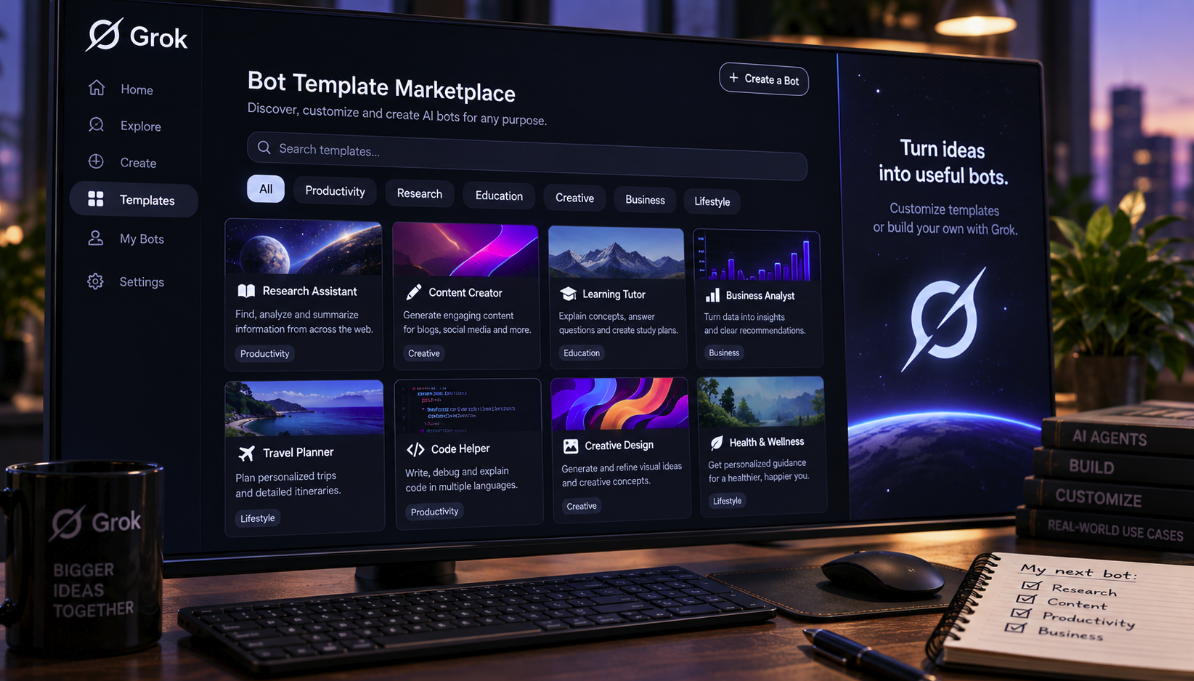
SpaceXAI's Grok Bot is moving from a tool for building autonomous workers toward something closer to a distribution platform for them. A new template marketplace lets users share preconfigured Bot blueprints, lowering the amount of setup required to turn a general AI agent into a sales researcher, recruiter, finance assistant or engineering worker.
BASENOR reported the marketplace rollout on September 4, describing a shared library of templates spanning professional categories. The feature matters less because templates themselves are novel — agent platforms have been moving toward reusable prompts, skills and workflows for some time — and more because Grok Bot gives each worker its own persistent identity, memory, tools and cloud computer. A reusable configuration can therefore represent considerably more than a saved prompt.
SpaceXAI has not yet published a detailed standalone marketplace announcement on its news page, so some marketplace-specific details currently come from BASENOR's reporting rather than primary documentation. But the broader product architecture is documented extensively by SpaceXAI, and it explains why sharing Bots could become strategically important.
Grok Bot is designed around workers, not conversations
Grok Bot launched in beta on August 11 as a set of always-on agents that can operate their own computers, sign into applications and continue working without the user watching each step. Rather than treating every interaction as a disposable chat, SpaceXAI treats a Bot as a persistent worker that users return to over time.
That distinction became even clearer in SpaceXAI's September 3 explanation of the product's design. The company describes five core objects: Bots, chats, prompts, tools and artifacts. Bots retain identity, memory, runtime and tools; prompts can become reusable Skills or scheduled and event-driven Routines; tools let the agent interact with software, APIs, connectors, shells and computers.
Once those pieces are assembled, the valuable object is no longer just the underlying model. It is the configuration that tells the model what job it owns, what context it remembers, which tools it can use and how it should perform recurring work.
A marketplace makes that configuration portable. Instead of every customer independently discovering how to build a useful procurement agent or recruiting agent, one successful design can become a starting point for many users.
The template is beginning to resemble an application
BASENOR reports that installing a marketplace template creates an independent copy in the recipient's account rather than granting access to the creator's running Bot. The transferable configuration can include the Bot's identity, description, instructions, selected memories, skills, routines and first-party plugins, while sensitive resources such as login credentials, conversation history, API keys and custom infrastructure remain with the original user.
If that separation works as described, it is an important security and product decision. A reusable Bot needs enough configuration to reproduce useful behavior without becoming a package for accidentally distributing credentials or private corporate context.
It also suggests an emerging software primitive. Traditional applications package executable code and an interface. Agent templates package intent, behavioral instructions, tool choices and workflow knowledge around a general-purpose model. The runtime and intelligence come from the platform, while the template supplies the specialized operating procedure.
That does not make templates equivalent to conventional software. Their behavior is less deterministic, and results can change as models, websites and external services change. But from a user's perspective, a good template can still behave like an installable capability: choose a job, connect the required accounts and delegate.
SpaceXAI is already encouraging Bot-to-Bot distribution
The marketplace fits naturally with the way SpaceXAI describes Grok Bot for enterprises. In its September 3 enterprise launch, the company explicitly says that once a user has built a Bot that works well, the configuration can be handed to a colleague as a template. Bots can also message one another and share context.
That combination creates the possibility of organizations building internal catalogs of specialized workers. A sales organization might standardize a prospecting Bot, a meeting-preparation Bot and a follow-up Bot. Finance could maintain procurement and renewal agents. Engineering could distribute Bots for code review, incident triage and release checks.
The marketplace takes the same concept outside an individual organization. A useful workflow can potentially move from one team to another without requiring each recipient to understand the underlying prompt engineering, tool configuration and routines.
This is where the feature could become more consequential than a gallery of example prompts. Software ecosystems grow when expertise can be packaged and redistributed. Agent ecosystems may grow when effective delegation patterns can be packaged in the same way.
The procurement example shows what a template can encode
SpaceXAI has already published a concrete example of a specialized Bot. On September 4, the company described an internal procurement agent called Haggle Bot that reads vendor spending, contracts and usage data, compares market pricing and prepares negotiation opportunities. SpaceXAI says the experiment identified more than $100,000 in direct savings.
That number is a company-reported result from SpaceXAI's own deployment and should not be interpreted as a benchmark for other organizations. Procurement savings depend heavily on company size, contracts, data quality and the permissions granted to the agent.
The more interesting point is structural. “Procurement Bot” is not one instruction. Useful performance depends on knowing where contracts live, how spending is represented, which data to compare, when to escalate a decision and what output a human negotiator needs. A reusable template can encode parts of that operational knowledge.
Once templates capture real procedures rather than generic personas, their creators begin contributing something analogous to lightweight software development. The scarce skill becomes understanding the work well enough to describe and constrain it for an autonomous system.
Plugins provide the execution layer
Templates become much more valuable when agents can actually act. Grok Bot's architecture allows Bots to use applications and websites through their own cloud computers, while connectors and plugins provide more direct ways to interact with services.
SpaceXAI has been building distribution infrastructure around this idea elsewhere in its product family. In June it launched the Grok Build Plugin Marketplace, an open catalog where coding-agent plugins can bundle skills, commands, agents, hooks, MCP servers and language-server integrations. Launch partners included MongoDB, Vercel, Sentry, Chrome DevTools and Cloudflare.
Grok Bot has also been gaining integrations quickly. On August 29, SpaceXAI added a direct X connector that lets Bots search posts, read timelines, inspect mentions and use X API credits. The enterprise product is positioned around Bots operating inside the same software workers already use.
The strategic pattern is recognizable: models provide reasoning, plugins and connectors provide capabilities, templates package workflows, and a marketplace distributes those workflows. Each layer increases the usefulness of the others.
The real marketplace question is trust
A marketplace for autonomous-agent templates also creates a different risk profile from a conventional prompt library. A saved writing prompt can produce bad prose. A Bot with access to email, Salesforce, GitHub or financial systems can produce real-world consequences.
Templates therefore need a clear boundary between configuration and authority. Installing a sales Bot should not silently inherit the creator's credentials or external access. Users should be able to inspect which tools, routines and permissions a template expects before enabling them.
SpaceXAI says Grok Bot environments are isolated and that Bots have no access by default until users sign them into accounts. Its enterprise release also adds access, network and audit controls intended to let organizations govern Bots at scale. Those controls become more important as templates make agent creation easier.
Ease of installation creates a familiar marketplace tension. The faster users can deploy third-party configurations, the more important review, provenance, permissions and update behavior become. Mobile app stores spent years developing mechanisms for those problems. Agent marketplaces will have to solve similar issues while dealing with software whose actions are probabilistic rather than completely predetermined.
Templates could create a new creator economy — but that is not proven yet
The natural next question is whether people will eventually sell sophisticated Bot templates. BASENOR describes the current marketplace as a sharing and discovery system; there is not yet enough official evidence to assume a paid template economy or revenue-sharing model.
Still, the ingredients are visible. A specialist who knows how to construct an effective recruiting workflow, sales-research process or financial analysis agent could package expertise in a form other users can install. If marketplaces eventually add ratings, verification and payments, agent configuration could become a commercial product category of its own.
The analogy to an app store should therefore be used carefully. Today's template marketplace does not appear to reproduce the full economics or governance of Apple's App Store or similar ecosystems. It is closer to a library of reusable agent configurations. But reusable configurations are exactly the kind of primitive from which a richer marketplace can grow.
Distribution may become as important as model quality
AI companies still compete intensely on benchmark scores, context windows, inference costs and coding performance. Persistent agents introduce another competitive dimension: how quickly users can turn those capabilities into reliable work.
A slightly better model does not automatically win if every customer has to construct workflows from scratch. A platform with a large catalog of proven templates and integrations can reduce time to value. Each successful workflow can attract more users, whose improvements can produce more templates, creating the beginnings of a distribution flywheel.
SpaceXAI appears to understand that dynamic. Grok Bot expanded to more subscription tiers on August 26, gained X integration on August 29, received enterprise governance controls on September 3 and is now being paired with reusable community templates. The cadence suggests the company is treating autonomous workers as a platform rather than a single feature.
The important metric will not be how many templates exist. Prompt marketplaces have demonstrated that large catalogs can fill quickly with near-duplicates and low-value configurations. The meaningful question is whether templates consistently shorten the path from installing a Bot to completing economically useful work.
If they do, agent marketplaces could become a new software distribution layer. Users would no longer choose only which AI model to subscribe to. They would choose an ecosystem of prebuilt digital workers, install the ones suited to their jobs and customize them with their own data and permissions. Grok Bot's marketplace is an early test of whether autonomous AI can make that transition from something people configure manually into something they simply deploy.