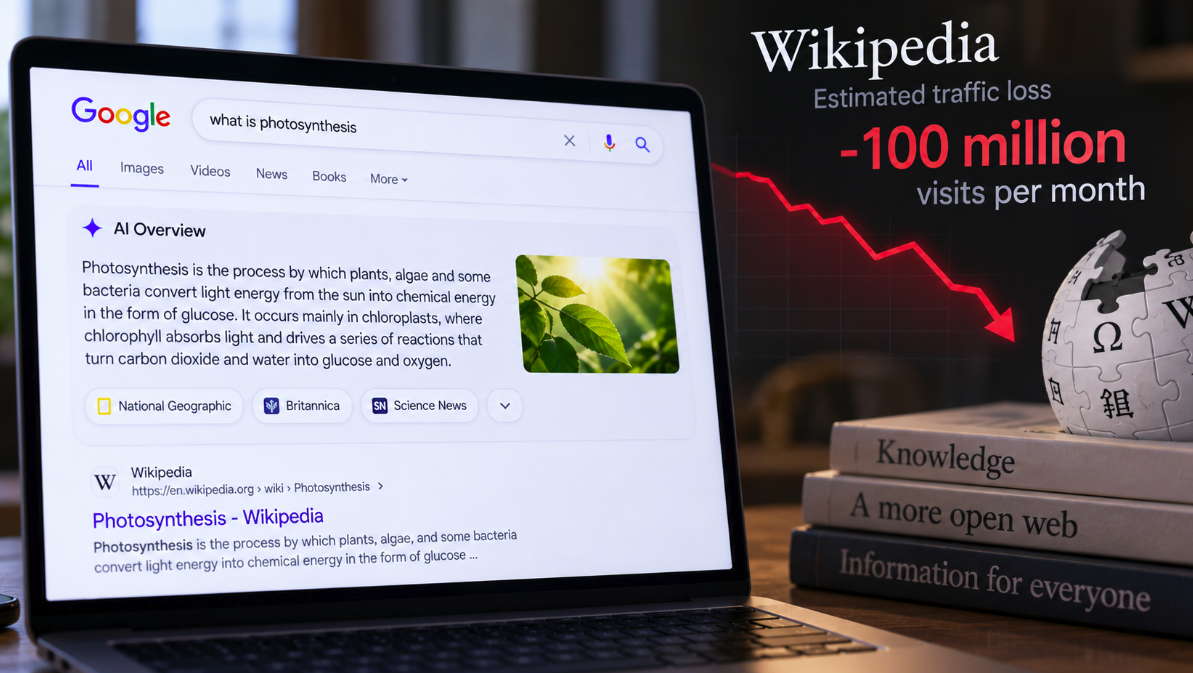
Google's AI Overviews may be reducing search-originated traffic to English Wikipedia by roughly 5%, according to a revised University of Washington study. Because Wikipedia operates at extraordinary scale, the researchers translate that mid-single-digit effect into approximately 100 million fewer visits every month.
The estimate, highlighted by NetContentSEO on September 5, is large enough to sound like a verdict on AI search. It is not. The research is a preprint, Google disputes its methodology, and the 100 million figure is an estimated counterfactual rather than a directly observed count of people who saw an AI Overview and decided not to click Wikipedia.
But the deeper issue survives those qualifications. Wikipedia is simultaneously becoming more valuable to AI systems and potentially less visited by the humans those systems are serving. That inversion — machines consuming more of a knowledge resource while humans increasingly receive its value somewhere else — may be one of the most important economic problems facing the open web.
The revised study finds a smaller but still substantial effect
The paper, Impact of AI Search Summaries on Website Traffic: Evidence from Google AI Overviews and Wikipedia, is by University of Washington researchers Mehrzad Khosravi and Hema Yoganarasimhan. The current version was revised on August 26 and uses the staggered rollout of Google's AI Overviews to estimate how answer-generating search affects upstream traffic.
The researchers compare external-search referrals to English Wikipedia articles with referrals to corresponding German and French Wikipedia articles. Their difference-in-differences estimates indicate that default AI Overview availability reduced English Wikipedia's search traffic by 5.45% relative to the German comparison and 4.82% relative to the French comparison.
Those numbers supersede an earlier version of the research that produced a decline closer to 15%. The revision is important. Preprints are working research, and estimates can change when authors alter samples, controls or methodology. Turning an early figure into a permanent industry statistic before the work stabilizes can produce misleading narratives.
The newer result is less dramatic in percentage terms but still enormous in absolute scale. Brazilian publication UOL reported that the authors translate the estimated effect into approximately 100.27 million fewer visits per month, or around 1.2 billion visits if a similar monthly loss persisted for a year.
The 100 million visits were not directly counted
The headline needs careful interpretation. Researchers cannot observe the alternate universe in which Google did not make AI Overviews the default in the treated market. They construct that counterfactual statistically.
The study uses the behavior of comparable Wikipedia language editions as controls. If English, German and French traffic followed sufficiently similar patterns before the rollout and English traffic diverged afterward, the change can provide evidence consistent with an AI Overview effect.
That is stronger than simply observing that Wikipedia traffic fell after Google launched a new feature. A before-and-after chart alone could be distorted by seasonality, changes in user behavior, competing platforms or unrelated developments at Wikipedia. The control groups attempt to isolate the treatment.
But causal inference depends on assumptions. The 100 million figure should therefore be described as estimated missing traffic under the model, not as 100 million individually observed clicks intercepted by Google.
Google's methodological objection is real
Google has challenged the study, calling its conclusions “deeply misleading” in a statement reported by UOL. One of the company's objections is technically important: Wikimedia's external-search referral metric combines traffic from multiple search engines, while the treatment being studied is specifically Google's AI Overview rollout.
Ideally, a causal study of a Google product change would isolate Google referrals from Bing, DuckDuckGo and other engines. Combining them creates a mismatch between the treatment and the outcome being measured.
That limitation does not automatically reverse the result. If Google represents the overwhelming share of the relevant search traffic and the other engines did not experience a coincident change that differed systematically across the language groups, non-Google referrals could primarily dilute the measured treatment. But that is an empirical question, not something that can be assumed away.
There is also a geographic complication. English Wikipedia serves a worldwide audience, while the initial treatment was the U.S. rollout of AI Overviews. Traffic from Britain, Canada, Australia and other English-speaking markets is mixed into the same language edition even though those users were not necessarily exposed to the identical Google environment at the same moment.
These are exactly the kinds of issues peer review, replication and alternative datasets need to test. The appropriate conclusion today is evidence of a potentially meaningful causal effect with material limitations — not a settled bill for 100 million stolen clicks.
Wikimedia was already seeing a decline in human readership
The new academic estimate matters partly because it aligns directionally with concerns the Wikimedia Foundation has raised independently. In October 2025, Wikimedia reported an approximately 8% year-over-year decline in human pageviews after improving its systems for separating human visitors from bots.
The Foundation said it believed the decline reflected changing information habits, including generative AI and social platforms, while noting that the trend could not be assigned to one cause. Search engines increasingly answer questions directly, and younger users often begin information discovery on social video platforms rather than the conventional web.
That 8% figure should not be combined mechanically with the University of Washington estimate. They measure different things over different periods. One is Wikimedia's observed human-pageview trend across its projects; the other is an econometric estimate of the effect of a specific search-interface change on external-search referrals to English Wikipedia.
Together, however, they describe the same structural direction: Wikipedia's information can reach users without those users necessarily visiting Wikipedia.
The paradox is that AI needs Wikipedia more as people may visit it less
Wikipedia is not simply another publisher exposed to generative search. It is part of the knowledge infrastructure supporting generative search itself.
At its 25th anniversary in January, the Wikimedia Foundation said Wikipedia contains roughly 65 million articles across more than 300 languages and receives nearly 15 billion views per month. The Foundation also describes Wikipedia as one of the highest-quality datasets used in training large language models and notes that its knowledge powers chatbots, search engines and voice assistants.
That creates an unusual loop. Human volunteers research, debate, cite and maintain knowledge. Search and AI systems ingest that knowledge. The systems can then synthesize it for users before those users reach the original encyclopedia.
From the user's perspective, this can be extremely efficient. A direct answer to a simple factual question may be better than requiring someone to open several pages. From the ecosystem's perspective, however, the transaction has changed. The downstream interface receives the user's attention while the upstream knowledge commons continues paying the cost of creating and maintaining the information.
Wikipedia's business model hides part of the economic problem
Wikipedia does not run display advertising, so 100 million fewer pageviews do not translate directly into a conventional publisher's lost ad inventory. That makes Wikipedia financially unusual and analytically useful.
The research paper explores what a similar traffic decline could mean for an advertising-supported publisher, producing a hypothetical annual revenue range of roughly $10.8 million to $37.1 million under its assumptions. That calculation is illustrative; it is not lost Wikimedia revenue.
For Wikipedia, traffic still matters in less direct ways. Readers can become editors, donors and advocates. Visibility reinforces the cultural habit of consulting the encyclopedia and exposes users to citations, discussion pages and the processes through which its information is constructed.
A generated answer that extracts one fact can preserve the informational output while removing that surrounding context. Over time, fewer direct interactions could weaken the funnel through which people discover the community that produces the knowledge.
AI traffic is expensive even when it does not become human traffic
There is another asymmetry. While human readership can decline, automated demand for Wikimedia data can increase. In July 2026, Wikimedia said bots had surpassed human traffic on the broader internet and described heavy automated extraction of Wikimedia content by AI and technology companies.
The Foundation has previously warned that sophisticated crawlers can impose disproportionate infrastructure costs. Its commercial Wikimedia Enterprise service exists partly to give high-volume reusers a more sustainable way to access the data rather than repeatedly scraping consumer-facing infrastructure.
This creates the uncomfortable possibility that a knowledge publisher receives fewer human visits while serving more machine consumption. The content becomes more economically useful to intermediaries at the same time that the original destination captures less attention.
Commercial publishers face an even harsher version of that equation because they often fund content production with advertising, subscriptions, ecommerce or lead generation that occurs after a visit. If the answer layer removes the visit, attribution alone may not replace the lost economics.
Google can be right about click quality while publishers are right about volume
Google has consistently argued that AI-powered search can create useful outbound visits and that users who click after reading a generated summary may arrive with more context. That claim and the traffic-substitution hypothesis are not mutually exclusive.
An AI Overview can reduce the number of users who need to click while making the remaining clicks more qualified. For a publisher, the outcome depends on both dimensions. Losing 20% of visits could be acceptable if the remaining audience becomes dramatically more valuable; it could be devastating if engagement improves only slightly.
This is why counting citations is not enough. Publishers increasingly need to measure whether they appear inside AI answers, whether those appearances generate visits and what those visits actually do. Visibility, traffic and value are separate variables.
Wikipedia makes the first two especially visible because its informational content is highly compressible. A date, definition, biography summary or short explanation can often be answered directly. Long historical narratives, references, tables and contested topics still create stronger reasons to visit the underlying article.
The open web has a replenishment problem
The long-term issue is not whether Google owes Wikipedia exactly 100 million visits. It is whether an answer-first internet can continue replenishing the sources it depends on.
Generative systems are extraordinarily effective at turning existing information into convenient interfaces. They are less capable of independently reproducing the institutional and social processes that create trustworthy new information: reporting, scientific research, expert documentation, community moderation and Wikipedia's volunteer consensus-building.
If downstream systems progressively capture attention while upstream sources retain the cost of production, some categories of information will become harder to fund. Wikipedia is buffered by donations and its nonprofit mission. Local newsrooms, specialist reference sites and independent publishers have much less protection.
The ecosystem therefore needs more than a debate about whether an AI Overview contains a blue link. Sustainable machine access, licensing arrangements, attribution, direct audience relationships and business models that reward original information will all matter.
Wikimedia Enterprise is one early example of that adaptation: large commercial users can pay for reliable high-volume access even though the underlying knowledge remains freely available to the public. Other publishers will experiment with licensing, subscriptions, APIs and restrictions on automated access.
The most important number may still be ahead
The University of Washington study is valuable precisely because it attempts to estimate an aggregate market effect rather than displaying a dramatic click-through chart for a handful of queries. A 5% shift can look modest until it is applied to one of the world's largest information resources.
Its current estimate still needs replication, and its own revision from roughly 15% to around 5% demonstrates why emerging AI-search statistics should be versioned and reported cautiously. Future research that isolates Google referrals geographically and measures individual AI Overview exposure could substantially strengthen or modify the result.
But the debate should not stop at whether the correct figure is 100 million, 50 million or something else. The more consequential metric is the relationship between machine consumption and human participation. If Wikipedia becomes ever more important as infrastructure for AI while fewer people encounter the encyclopedia, its citations and its volunteer community directly, the internet will have created a strange dependency: a knowledge system that downstream products increasingly need but upstream users increasingly bypass.
That is why Wikipedia is a warning for the rest of the web. AI search does not have to destroy a publisher to change its economics. It only has to move enough of the information transaction away from the source. At Wikipedia's scale, even a mid-single-digit shift is large enough to show what that transition can mean.