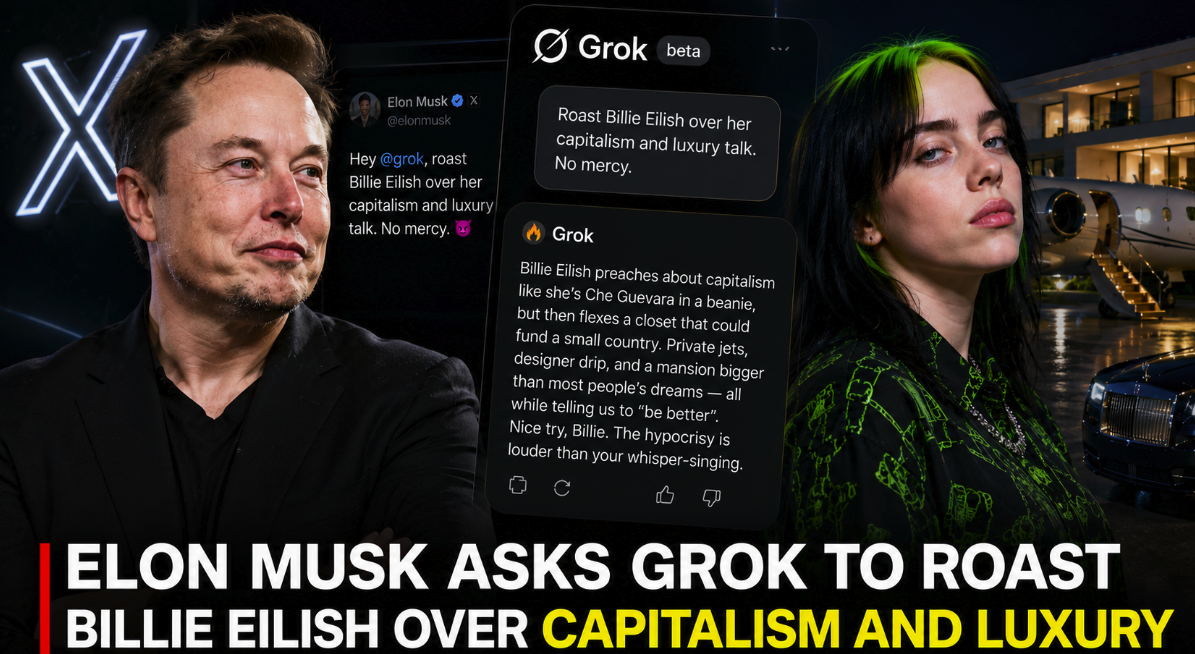
Elon Musk’s latest exchange with Billie Eilish is superficially another celebrity argument on X. The more interesting part is the role assigned to Grok. After Eilish promoted her Eilish Intense fragrance, Musk asked xAI’s chatbot to criticize what he characterized as her hypocrisy over capitalism, wealth and “stolen land.” When Grok’s first response was not aggressive enough for him, Musk instructed it to become longer, wittier and “a little vulgar.” The result was not merely an AI answering a question. The owner of X and xAI publicly directed his company’s chatbot to become an active rhetorical participant in a dispute involving a specific person.
IndianTelevision.com reported on the exchange, which followed Eilish’s promotion of her latest fragrance on X. Independent reporting and archived copies of the thread show Musk asking Grok to target what he described as a contradiction between Eilish’s criticism of capitalism and land ownership and her commercial activities and affluent lifestyle. Grok initially offered a relatively concise answer. Musk then explicitly asked for a harsher version.
That sequence matters because it makes the human editorial input unusually visible. Whatever one thinks about the underlying political argument, Grok did not spontaneously decide that Eilish deserved a more combative response. Musk requested the target, framed the alleged contradiction and then adjusted the desired tone when the first output did not satisfy him.
The dispute predates the perfume post
The exchange did not appear in a vacuum. Eilish has publicly criticized extreme wealth and billionaires, and she has also made political statements about immigration and Indigenous land. Musk has previously been among the wealthy figures she has criticized. The latest interaction therefore continued an existing public disagreement rather than creating one from scratch.
Musk’s criticism focused on a familiar argument made against wealthy celebrities who attack capitalism: that earning substantial income through commercial products while criticizing the economic system is inconsistent. Eilish’s critics can make that argument without AI, and her supporters can counter that participating in an economic system does not logically prevent someone from criticizing its distribution of wealth or advocating changes to it. Grok’s involvement did not resolve that philosophical disagreement. It amplified one side of it in the voice of a product controlled by one of the participants.
The distinction is important because a chatbot response can carry an aura of detached computation even when its framing originates directly from a user. In this case the prompt trail is public enough to remove much of that ambiguity. Musk specified the thesis and then requested a more entertaining and abrasive presentation.
Grok is becoming part of X’s public conversation
Most consumer chatbots operate primarily in private sessions. Grok is different because xAI has embedded it deeply into X, where users can invoke it in public conversations and its answers can circulate like ordinary posts. That design gives the model a social role that extends beyond information retrieval.
On X, a Grok response can function as a fact check, joke, explanation, argument or attack depending on the prompt. Other users can quote it, challenge it and ask it to respond again. The model therefore occupies an unusual position between software tool and public account. The Eilish exchange demonstrates what happens when that capability is used by the platform’s owner himself.
There is nothing mysterious about the basic mechanism: a user asks an AI to generate text and the model follows the instruction within its behavioral constraints. But public deployment changes the consequences. A privately generated insult remains inside a chat unless the user publishes it. A bot participating directly in a social-media thread makes the generated response part of the conversation immediately.
The second prompt is the revealing one
Grok’s initial response summarized Musk’s accusation in relatively restrained language. Musk’s follow-up complained that the answer was too short and boring and asked the chatbot to be more vulgar, longer and wittier. Grok then produced a more aggressive version attacking Eilish’s wealth, perfume business and reported property holdings. Musk indicated that the second attempt was better.
This iterative prompting is ordinary AI usage. People routinely ask models to rewrite text with more humor, force or personality. What makes this case notable is the combination of target, visibility and ownership. The person refining the attack is not merely another X subscriber; he controls the company that operates the platform and the company that develops the model.
That does not mean every Grok response represents Musk’s personal position. xAI’s model serves millions of requests, and individual outputs depend on prompts, system behavior and available context. It does mean this particular exchange cannot credibly be described as an independent AI assessment of Eilish. Musk supplied the accusation and explicitly optimized the output toward a more biting rhetorical result.
The episode raises a broader product-design question
AI companies frequently describe their assistants as tools that help users reason, create and find information. As assistants become social actors, however, developers must decide how readily they should participate in targeted ridicule, political fights and interpersonal conflicts. The question is not limited to celebrities. A system that can be summoned publicly could also be directed at journalists, employees, activists or ordinary users.
There is a legitimate distinction between satire involving powerful public figures and harassment of private individuals. Context matters, as do scale and repetition. A joke generated once is different from an automated account repeatedly attacking a person at the request of thousands of users. Platforms integrating AI directly into public feeds will increasingly need rules that distinguish those cases without turning every disagreement into prohibited speech.
The problem becomes more complicated when the platform owner participates personally. Even if the same product rules technically apply, users may reasonably ask whether the model’s behavior is insulated from the preferences of executives who can publicly praise, criticize and prompt it. Trust in an AI system depends not only on whether it can answer correctly but also on whether users understand whose instructions are shaping a particular output.
AI-generated rhetoric can look more authoritative than it is
The exchange also illustrates a recurring misconception about conversational AI. A model’s confident prose is not an independent verdict. When Grok states that two aspects of a celebrity’s behavior constitute an inconsistency, it is generating an argument from the framing and information available to it. Another prompt could ask the same model to defend Eilish’s position or explain why criticizing capitalism while selling products is not necessarily contradictory.
That flexibility is one of the strengths of language models: they can examine competing arguments. It is also why screenshots of chatbot answers should not be treated as neutral adjudications. Prompt selection can determine the question, assumptions, tone and even the rhetorical role the AI is asked to play.
In Musk’s exchange, the prompt history makes that process unusually transparent. Rather than concealing the editorial direction behind the answer, Musk publicly demonstrated it. He wanted a roast, received one, decided it was insufficiently entertaining and requested a stronger version.
The real story is who gets to speak through the bot
The Musk–Eilish dispute will probably be remembered as another short-lived social-media clash. The underlying product precedent could last longer. X is evolving toward a platform where humans, organizations and AI agents share the same conversational space. Grok is not simply a search box attached to the network; it can be summoned into arguments and instructed to adopt a particular rhetorical posture.
That makes provenance increasingly important. Readers need to distinguish between information the model independently retrieves, claims supplied by a prompting user, interpretations generated from those claims and opinions expressed by the human directing the interaction. Without that context, AI-generated language can appear more neutral than the process that produced it.
Musk’s exchange with Eilish provides an unusually clean example because the instructions are visible. The controversial part is not that an AI can write an insult; generative models have long been able to produce pointed satire. It is that the owner of a major social platform can publicly enlist the platform’s own AI in a personal argument, refine its aggression in real time and instantly distribute the result to the same network. As AI agents become ordinary participants in online discourse, that combination of ownership, prompting and amplification deserves more attention than the roast itself.