X and xAI are tightening the connection between Grok Bot and the social network by giving paid Bot users free X API credits when they connect their accounts. On the surface, it is a small developer incentive. Strategically, it points to something much larger: AI agents are becoming more valuable when they have privileged, structured and economically favorable access to proprietary data that competing assistants cannot reproduce simply by improving their models.
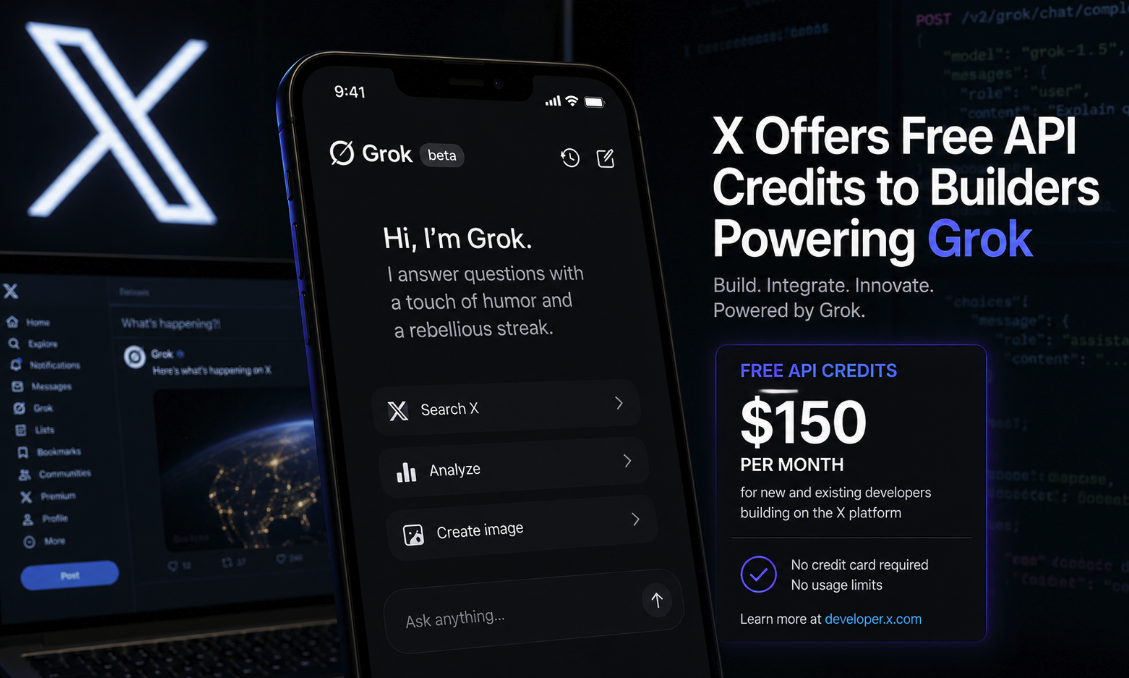
Social Samosa reported that connecting an X profile to Grok Bot can automatically create a developer account for users who do not already have one, while paid Grok Bot subscribers receive free X API credits to get started. The integration allows a Bot to search posts, read a timeline, check mentions and compile information about activity and trends on X.
The underlying announcement from xAI confirms the integration and describes it as the first version of tighter support between Grok Bot and X. The company has not publicly specified the value of the free credits in that announcement, so the offer should not be interpreted as unlimited free access to X data. What matters is the direction: xAI is reducing the friction between buying an AI agent and giving that agent programmatic access to X.
Grok Bot is not just another chat interface
xAI launched Grok Bot in August as a persistent agent product rather than a conventional question-and-answer assistant. The company describes Bots as AI teammates that operate on their own cloud computers, can use applications and connectors, request approvals and run routines. That architecture changes what access to X means. A chatbot can answer a question about social media; a persistent agent can repeatedly monitor it as part of an ongoing job.
Consider a communications team tracking reactions to a product launch. A connected Bot could periodically inspect mentions, identify recurring complaints, compare conversations over time and prepare a report. A researcher could ask it to monitor discussion around a technical topic. A creator could use it to understand which posts are generating responses without manually reviewing a timeline. These are not guaranteed capabilities in every workflow, but they illustrate why structured platform access becomes more valuable when an agent can operate continuously.
The key word is structured. An agent that relies only on ordinary web browsing has to discover pages, parse interfaces and work around whatever information is publicly visible. An API provides defined endpoints and machine-readable data. It can make automated work faster, more reliable and easier to govern.
The subsidy solves a problem X created for developers
X API access has become a meaningful cost consideration since the platform moved away from the broadly accessible developer model associated with the Twitter era. X’s current developer documentation describes usage-based pricing and spending controls. That means an agent that continuously reads posts or monitors accounts can accumulate a data-access bill separate from the cost of running the AI model itself.
Free starter credits therefore reduce an important adoption barrier. Users can connect Grok Bot, receive a developer account if needed and experiment with X-powered workflows before deciding whether the value justifies ongoing API spending. This is a familiar platform tactic: subsidize the first units of a complementary resource to encourage adoption of the product that makes that resource useful.
The relationship also works in the other direction. X’s API pricing documentation offers free xAI API credits to developers based on their spending on X API credits, provided they link their xAI team to their X developer account. At higher spending tiers, the reward rate rises. Taken together, the programs create an economic bridge between X data consumption and xAI model consumption.
Data access may become more defensible than model intelligence
Frontier AI models are improving quickly, but raw model capability is increasingly available through multiple vendors, clouds and development environments. xAI itself distributes Grok through several external platforms. If customers can choose among multiple strong models, vendors need additional reasons for users to remain inside their ecosystem.
Proprietary data is one of those reasons. X contains a continuous stream of public conversation, breaking information, commentary and reactions. Other AI companies can index parts of the public web and may have their own agreements or search technologies, but xAI’s corporate relationship with X gives it an unusually direct path to integrating the platform into its own agent products.
This does not automatically make Grok’s answers more accurate. Social-media posts can be wrong, manipulated, repetitive or unrepresentative. Real-time access is useful only when the agent can distinguish a primary source from speculation and a genuine trend from coordinated noise. But for tasks where the object of analysis is X itself — mentions, timelines, communities, reactions or account activity — first-party platform integration is inherently valuable.
Agents are turning APIs into product features again
For years, APIs were primarily discussed as tools for developers building applications. Agentic AI changes that relationship. A non-programmer can potentially request an outcome in natural language while the agent handles API calls behind the scenes. The user may never write code or even think of the task as API usage.
That helps explain why automatically creating a developer account is notable. Traditionally, a user would visit a developer portal, register an application, obtain credentials, study documentation and write software. xAI is attempting to collapse much of that setup into a connector. The API remains underneath, but the agent becomes the interface to it.
If this pattern succeeds, developer platforms may increasingly compete to become agent-accessible infrastructure. The winning API will not necessarily be the one individual programmers find easiest to call manually. It may be the one an AI agent can authenticate with, use safely and operate economically with minimal setup for the end user.
Permissions will matter as the integration expands
The first version emphasizes reading and analysis: searching posts, reading timelines, checking mentions and assembling information. That is a comparatively controlled starting point because the agent is gathering information rather than autonomously publishing content or changing account settings.
Broader write permissions would create a different risk profile. An agent capable of posting, replying or taking other actions on behalf of a user would need strong approval controls, clear attribution and defenses against prompt injection or malicious content encountered while reading the platform. Persistent agents amplify both utility and mistakes because they can act repeatedly without a human manually initiating every step.
xAI already emphasizes approvals as part of the Grok Bot model, and the gradual X integration gives the company an opportunity to establish those controls before adding more powerful actions. The security design could become as important as the underlying model quality if Bots are eventually allowed to manage meaningful parts of an X account.
The X–xAI loop is becoming visible
The free-credit program is modest compared with a new model release, but it reveals the shape of the ecosystem xAI is building. Grok supplies reasoning and agent execution. X supplies a large proprietary stream of current social data. API credits lower the cost of connecting the two, while developer-account automation removes setup friction.
That combination can create a feedback loop: more Grok Bot users connect X, more agent workflows depend on X data, and the value of using Grok rather than a model without equally direct platform access increases. Meanwhile, X gains more API consumption and another reason for professional users to treat its data as infrastructure rather than only as a social feed.
The important competitive question is therefore not whether a few free API credits are generous enough. It is whether vertically integrated AI companies can turn privileged access to their own platforms into durable agent advantages. If AI assistants converge in raw intelligence, the next battle may be decided by what each agent is allowed to see, what it can do and how cheaply it can keep doing it.