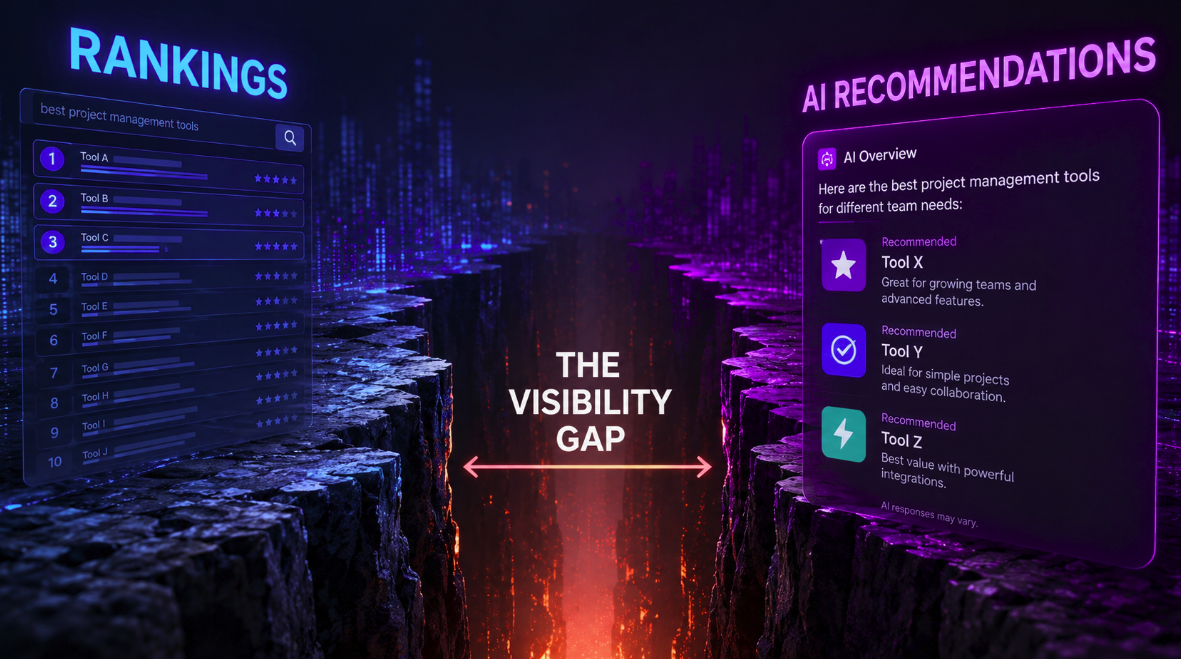
For years, search visibility was largely a question of position: where a page ranked, how often it appeared and whether users clicked it. Generative search is adding a more selective layer. A company can perform strongly in conventional organic search and still fail to appear when an AI assistant is asked to recommend a small set of products, services or brands.
This emerging gap between ranking and recommendation is documented in a recent NetContentSEO analysis of AI search visibility, which argues that marketers increasingly need to distinguish between being discoverable in search results and surviving the much narrower selection process behind an AI-generated shortlist. The distinction matters because recommendation interfaces can compress dozens of plausible competitors into only a handful of names.
Traditional authority still matters, but it does not determine the shortlist
The strongest recent evidence comes from research by Fractl covered by Search Engine Land. The study tested eight industries using GPT-4o, Gemini 2.5 Flash and Claude Sonnet 4.6. Each system received the same 96 industry-specific prompts, repeated 15 times per model, producing 4,320 responses and more than 8,500 unique brand references. Those results were then compared with conventional SEO indicators including organic traffic, keyword coverage and domain rating.
The broad result is more nuanced than the idea that AI has made SEO obsolete. More than nine in ten brands behaved roughly as expected: stronger traditional search authority generally coincided with stronger AI visibility. But a strategically important minority did not. Search Engine Land reports that about 5% of the brands were underexposed in large language model responses despite strong conventional SEO footprints, while roughly 4% appeared substantially more often than their traditional search metrics would predict.
Those outliers expose a new competitive question. A page ranking sixth on Google still occupies a visible position in a list. A brand excluded from a three- or five-company AI recommendation has no equivalent sixth-place exposure inside that answer. Before ranking within the generated response can matter, the brand has to enter the model's consideration set.
Third-party corroboration appears to separate some AI overperformers
One of the more consequential findings in the Fractl dataset is the relationship between AI visibility and independent coverage. Brands appearing disproportionately in roundups, comparisons, expert lists and other third-party material were often more visible in model responses than their conventional search strength alone would suggest. Conversely, some businesses with substantial organic traffic and keyword portfolios remained weakly represented in AI recommendations.
This does not establish a universal ranking factor, and it would be a mistake to reduce the finding to a formula such as “get more mentions and ChatGPT will recommend you.” Different AI products use different models, retrieval systems, source sets and ranking mechanisms. Some responses are generated primarily from model knowledge, while others involve live web retrieval. Still, the pattern supports an intuitive principle: when an AI system must recommend an entity rather than merely retrieve a relevant page, corroboration across the wider information environment can become particularly valuable.
That changes the role of owned content. A technically excellent product page can explain what a company claims about itself. Reviews, publisher coverage, customer stories, analyst material, partner pages and independent comparisons provide evidence about how other sources describe that company. Recommendation tasks naturally create more pressure to reconcile those signals because the assistant is effectively making a judgment about which entities belong in the answer.
AI visibility is not one metric
The recommendation gap also exposes a measurement problem. “AI visibility” is often treated as if it were a single equivalent of Google rank, but generative systems create several distinct forms of visibility. A website may be retrieved as a source, cited as supporting evidence, mentioned as an entity or explicitly recommended to the user. Those outcomes are related, but they are not interchangeable.
The NetContentSEO article proposes separating source visibility, citation visibility, brand or entity mentions and recommendation share. That framework is useful because a publisher cited for factual evidence is not necessarily the company the assistant ultimately recommends. Likewise, a brand can appear in a recommendation without its own website being the visible citation supporting the answer.
Cross-model differences make a single blended score even less reliable. In Fractl's dataset, only 11% of brands were referenced by all three tested models, while 12% appeared in two and 77% were referenced by only one. A business can therefore look highly visible in one AI ecosystem and effectively disappear in another. Reporting an average without preserving those differences can conceal the actual competitive weakness.
Repeated testing is essential
AI recommendations also vary between runs. A 2026 research paper, “Don't Measure Once: Measuring Visibility in AI Search (GEO)”, argues that generative-engine visibility should be measured as a distribution rather than inferred from a single output. Prompt wording, repeated sampling and time can all affect which sources or entities appear.
That makes recommendation visibility fundamentally different from checking one deterministic search result. A serious measurement program needs matched prompt sets, repeated runs and model-specific tracking. It should record whether the brand appears, where it appears, how it is characterized, which competitors accompany it and what sources are cited. The interesting data lies not only in the winners, but in the mismatch between traditional search performance and repeated AI selection.
This methodology can also distinguish categorization problems from general visibility problems. A model may know a famous company extremely well but fail to associate it strongly with the category in which the company wants to compete. Search Engine Land's analysis highlights several examples where large brands underperformed in particular category prompts despite enormous conventional web footprints. Producing more generic content would not necessarily solve that problem; strengthening consistent category associations across independent sources may be more relevant.
Local search shows how severe compression can become
The selection effect may be especially consequential in local search, where users frequently ask for a small number of actionable recommendations. The NetContentSEO analysis cites 2026 Local Visibility Index research from SOCi, reported by Search Engine Land, comparing visibility across hundreds of thousands of locations and thousands of multi-location brands. The reported gap between conventional local visibility and AI recommendations was substantial, with AI systems selecting a far smaller portion of eligible businesses.
Those figures should not be interpreted as a direct conversion rate from Google rankings to AI recommendations because the systems and measurement methodologies differ. They do, however, illustrate the structural effect of compression. A local results interface can expose multiple nearby businesses, maps, reviews and additional pages of results. An assistant answering “Which three should I choose?” has to eliminate most of them.
That elimination stage increases the importance of accurate business data, review signals, sentiment, category consistency and corroborating information across the web. Local optimization is therefore likely to retain its existing foundations while gaining another objective: ensuring that the business is sufficiently well understood and supported to be selected when an AI system reduces the market to a shortlist.
The economic value is shifting toward inclusion in the answer
The stakes increase if users increasingly accept the AI-generated conclusion without visiting many sources. The 2026 paper “Answering Without Referring: How AI Search Rewrites the Web's Economic Bargain” examines this broader tension, finding substantially lower outbound referral behavior in ChatGPT information-seeking sessions than in conventional Google search sessions.
That does not mean links or rankings stop mattering. Search remains an enormous discovery system, and retrieval-based AI products themselves depend heavily on web content. But when an interface synthesizes the research before the user clicks, the commercial value of being named in the conclusion can rise relative to simply owning a page somewhere in the underlying source landscape.
The practical consequence is a second scoreboard for brands. Traditional SEO should continue measuring rankings, traffic, authority and technical accessibility. AI-oriented measurement should separately track recommendation frequency, citations, model-specific mentions and category association. The gap between those two scoreboards is likely to become one of the most useful diagnostic signals in search marketing.
The companies worth studying most closely will not necessarily be those that dominate both systems. They will be the anomalies: brands that rank strongly but disappear from AI shortlists, and smaller competitors that repeatedly become default recommendations. Understanding why those mismatches occur is more valuable than trying to invent a universal “AI ranking factor.” As generative interfaces compress markets into increasingly short answers, visibility is becoming not only a contest for position, but a contest to be selected at all.