Brain-computer interfaces are usually sold to the public through spectacular demonstrations: a paralyzed person moving a cursor by thought, a robotic limb responding to neural signals, or the long-term possibility of restoring speech and vision. But the technology's first large medical market may emerge from a less cinematic problem. Chronic pain could become an early proving ground for closed-loop neural interfaces because pain produces measurable neural activity, patients can rapidly report whether an intervention helps, and existing treatments still leave substantial unmet need.
That argument is at the center of a 36Kr Europe interview with Zhao Yun, founder and CEO of Beijing-based NewCloud Medical. Zhao's central point is deliberately less futuristic than the Neuralink narrative: today's systems are nowhere near general-purpose mind reading, and the commercially relevant question is which diseases neural interfaces can treat well enough that doctors will prescribe them and patients will ultimately pay for them.
The distinction matters because brain-computer interface, or BCI, has become an unusually broad label. It can describe invasive electrodes that record directly from neural tissue, systems placed above or below the dura, and non-invasive devices that infer intent from signals collected outside the skull. Those architectures trade signal quality against surgical risk, long-term stability and usability. There is no single technological route that currently maximizes all of them.
Reading an intention is not reading a mind
BCI demonstrations can create a misleading impression of what neural decoding actually does. A system trained to identify the neural activity associated with an intended hand movement is recognizing a constrained signal pattern. It is not extracting an unrestricted stream of thoughts, memories or beliefs. As Zhao argues in the 36Kr interview, even accurately decoding a specific motor intention remains an important technical achievement, but it should not be confused with knowing what someone is thinking.
Regulators frame the technology in similarly practical terms. The U.S. Food and Drug Administration's guidance for implanted BCI devices focuses on neuroprostheses intended to restore lost motor or sensory capabilities in people with paralysis or amputation. Its concerns include non-clinical testing, study design, device reliability and the long-term consequences of an implant — not science-fiction-style access to unconstrained thought.
This is why the gap between public attention and industrial maturity is so important. A striking laboratory result can establish technical feasibility without establishing a viable medical product. Implantable devices must survive clinical trials, regulatory review, surgery, long-term use and reimbursement. They must also deliver enough benefit to justify their cost and risk.
Pain creates a different kind of BCI opportunity
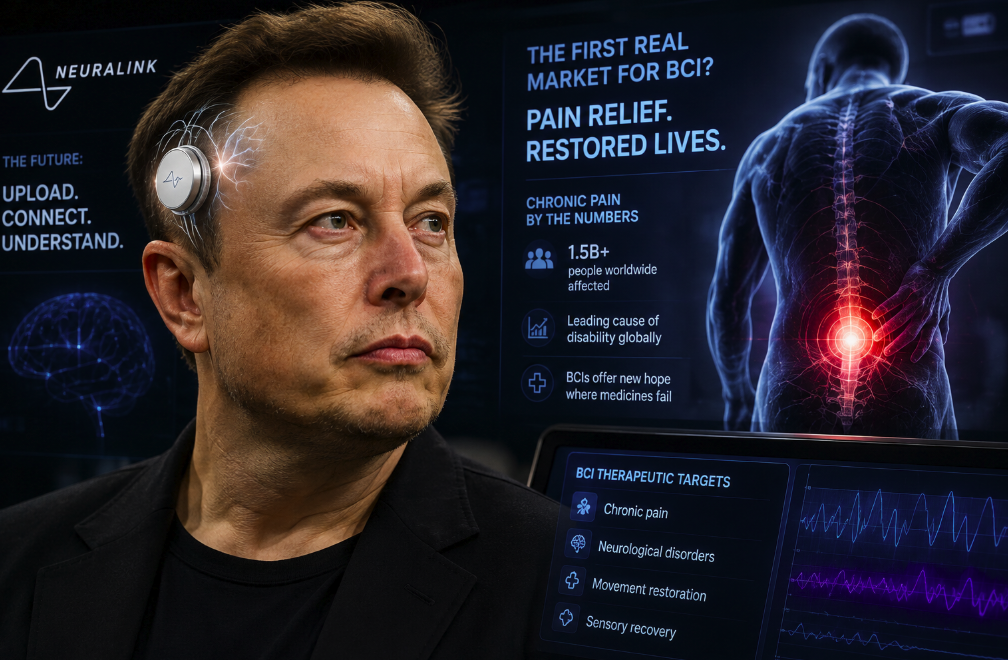
Chronic pain is especially interesting because it sits at the intersection of subjective experience and measurable neural activity. Clinicians routinely ask patients to rate pain because there is no simple equivalent of a thermometer for it. Yet pain is generated and modulated by neural circuits, creating the possibility that a system could detect relevant patterns and use them to guide stimulation.
The concept is a closed loop. Neural activity is recorded, an algorithm estimates a pain-related state, and stimulation is adjusted in response. The objective is not necessarily to eliminate pain, which has an important protective function, but to suppress pathological pain when it crosses a clinically meaningful threshold.
This is not merely a startup thesis. A 2024 review in Cell Reports Medicine described closed-loop neural interfaces as a potentially effective, non-addictive approach to chronic pain, while emphasizing that the field still spans animal studies and human pilot trials. Earlier work published in Nature Biomedical Engineering demonstrated a prototype closed-loop brain-machine interface that decoded pain-related activity and delivered responsive stimulation in preclinical experiments.
More recently, a 2026 Nature Neuroscience study used repeated precision fMRI measurements from two people with chronic pain to develop personalized models for decoding spontaneous pain. The sample was deliberately tiny and the method is not an implantable consumer-ready device, but the work illustrates an important direction: pain biomarkers may need to be individualized rather than treated as a universal neural signature.
NewCloud is betting on the clinical workflow, not the spectacle
NewCloud Medical's background helps explain why Zhao emphasizes pain rather than general-purpose human-machine interaction. The company was founded in 2016 around pain management and has historically developed technologies and clinical-service infrastructure for pain departments. A China Europe International Business School report says NewCloud has been developing an AI-based closed-loop rechargeable spinal-cord stimulation system and what it describes as a pain-focused brain-computer interface, in collaboration with research and clinical institutions.
Those company claims should not be mistaken for evidence that a commercially mature pain BCI already exists. The more significant point is the development strategy. Instead of building a general neural interface and then searching for applications, NewCloud is starting with a clinical problem it already knows: chronic pain, the workflows of pain departments and the shortcomings of existing neuromodulation.
That approach could matter because medical-device markets are shaped by more than technical performance. A device needs an identifiable patient population, clinicians trained to use it, a measurable outcome, a tolerable procedure, manufacturing economics and a reimbursement pathway. Pain offers a relatively fast feedback signal: patients can often tell clinicians whether an intervention has changed their symptoms without waiting months for a rehabilitation outcome.
China is building an industrial policy around BCI
The commercial backdrop is also changing rapidly. In July 2025, seven Chinese government bodies including the Ministry of Industry and Information Technology, National Health Commission and National Medical Products Administration issued an implementation plan for brain-computer interface industry development. It set targets for breakthroughs in key technologies and an initial industrial and standards system by 2027, followed by a more internationally competitive ecosystem by 2030.
The plan explicitly covers implanted, non-implanted and related neural-interface technologies, including electrodes, chips, decoding software, stimulation systems and medical applications. China is also developing technical standards for BCI medical devices. A national standard project for general technical requirements covering non-invasive BCI medical equipment was initiated in March 2026 and is currently progressing through the standards process.
Commercialization has already moved beyond pure research in some indications. Reuters reported in March 2026 that China approved a semi-invasive BCI medical device designed to help people with cervical spinal-cord injuries regain hand-grasping ability through a controlled glove. That milestone does not mean the broader BCI market is mature, but it shows that regulatory pathways are beginning to convert specific neural-interface applications into products.
Approval is only the beginning of the market test
Zhao's strongest argument is economic rather than neurological. Clinical-trial participation can demonstrate interest, but trial participants often do not bear the full cost of an experimental device. Commercialization introduces different questions: how much does the hardware cost, what does surgery cost, what will insurance reimburse, what must the patient pay and how much improvement does that expense buy?
This is where many forecasts for BCI risk getting ahead of the evidence. Regulatory approval proves that a device has cleared a defined threshold for a particular use; it does not guarantee broad adoption. Hospitals need trained teams and workable procedures. Patients must accept the risk and burden. Payers need evidence that the intervention produces sufficient benefit relative to alternatives. Implant longevity and maintenance become real-world concerns rather than engineering specifications.
Pain may provide an unusually clear test of that chain because the clinical need is large while the outcome is directly meaningful to the patient. But it is also a difficult target. Pain is affected by sensory processing, emotion, memory and individual context. A signal that works for one patient may not generalize cleanly to another, and responsive stimulation has to demonstrate durable benefit rather than a short-lived laboratory effect.
The first BCI winners may look more like medical-device companies
The popular BCI narrative tends to assume that the ultimate winner will be the company with the most impressive neural decoding. Healthcare markets reward a different combination of capabilities. Long-term device reliability, surgical practicality, clinical evidence, reimbursement, manufacturing cost and physician acceptance can be as important as the number of electrodes or the sophistication of the decoder.
That helps explain why chronic pain is strategically interesting. It reframes BCI from a new computing interface into a medical feedback system: detect an abnormal neural state, interpret it and intervene at the right moment. The technological ambition remains substantial, but the product can be evaluated against a specific disease burden rather than an open-ended promise of merging humans with machines.
Neuralink and other high-profile programs have been valuable in making brain-computer interfaces visible. Visibility, however, is not the same thing as an industry. The more revealing milestones over the next few years may be quieter ones: patients leaving hospitals with approved systems, clinicians using them repeatedly, insurers agreeing to pay and outcomes remaining meaningful months or years later.
If closed-loop pain systems can cross those thresholds, BCI's first mass-market medical success may arrive without anyone reading a thought. It may begin by learning to recognize when the nervous system is producing the wrong kind of pain — and responding before that signal takes over a patient's life.