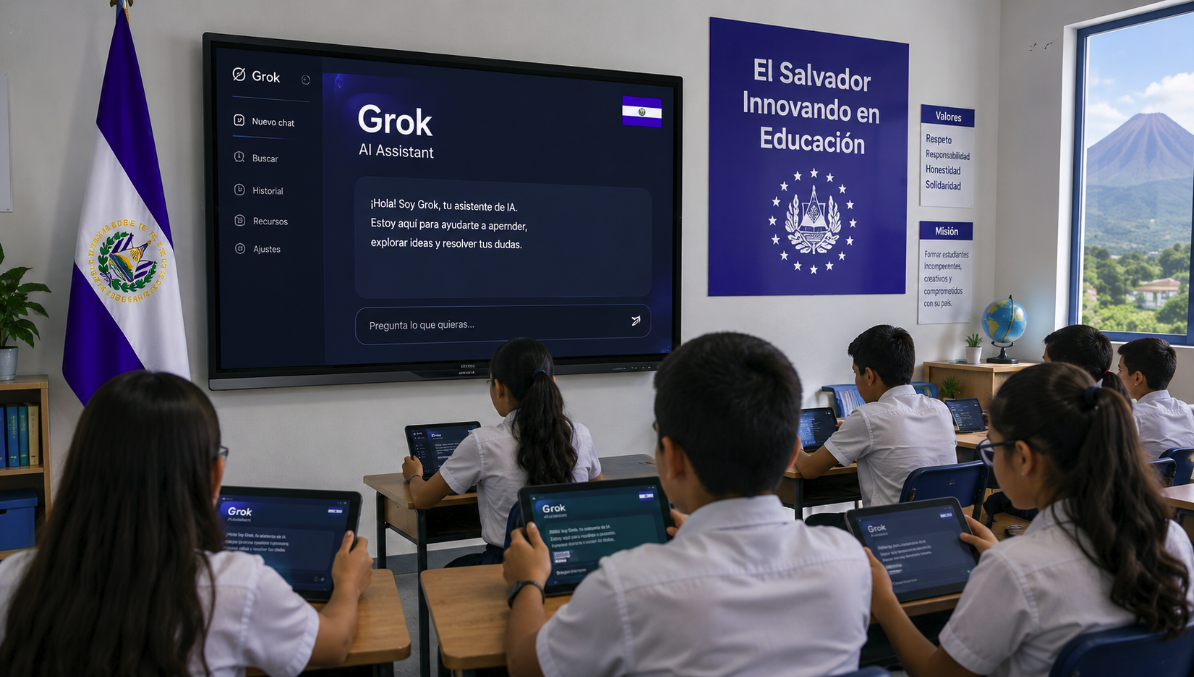
El Salvador’s plan to put xAI’s Grok into its public-school system is moving beyond the kind of classroom AI experiment that can be judged by a few enthusiastic teachers or a short pilot. The partnership announced in December 2025 is intended to reach more than one million students across more than 5,000 public schools over two years. At that scale, the important technology is no longer simply the chatbot. It is the institutional machinery around it: curriculum controls, teacher training, connectivity, child-data rules, model monitoring and evidence that students actually learn more.
That distinction matters because the official ambition is unusually broad. xAI says it is co-developing an adaptive, curriculum-aligned tutoring system with El Salvador rather than merely distributing consumer Grok accounts. The Salvadoran presidency describes the initiative as the first nationwide personalized AI tutoring deployment across an entire public-school system. If that vision becomes operational, one commercial frontier model will occupy a role much closer to education infrastructure than ordinary classroom software.
The announcement is eight months old; implementation is the story now
The xAI partnership was announced on December 11, 2025, with a two-year deployment horizon. The companies said Grok would adapt instruction to each student’s pace, preferences and mastery while involving thousands of teachers as partners. Crucially, they also promised to develop methodologies, datasets, governance, auditing and safety frameworks that could inform AI deployments elsewhere.
Public evidence since then shows the project remains part of El Salvador’s education agenda, although the available information does not establish that a finished Grok tutor is already operating daily in all 5,000-plus schools. In May, Education Minister Karla Trigueros said development of the xAI education platform was advancing. Reporting in August on her first year in office described a wider curriculum overhaul incorporating artificial intelligence, programming, cybersecurity and financial education, alongside training for 10,000 teachers.
The distinction between a planned national rollout and a completed one is essential. Governments can count schools, accounts and devices quickly; demonstrating effective educational integration takes much longer. For other countries considering similar partnerships, the useful data will be mundane but decisive: which grades are using Grok, in which subjects, for how many minutes per week, with what teacher controls and under what connectivity requirements.
Personalization is a promise, not yet an outcome
AI tutoring has an intuitive appeal in systems where teachers cannot provide individualized attention to every student. A well-designed tutor can identify a misconception, offer another explanation, adjust the difficulty of the next exercise and allow a student to practice without waiting for a teacher to become available. At national scale, that could make individualized academic support much less dependent on geography or family income.
But personalization should not be confused with effectiveness. A system can produce a different response for every child without improving reading comprehension, mathematics or science achievement. It can also personalize the wrong explanation. Large language models are capable of generating fluent, plausible errors, and classroom use raises the stakes because students may not possess enough subject knowledge to recognize them.
El Salvador and xAI therefore have an opportunity to make outcome measurement part of the infrastructure from the beginning. Useful evaluation would compare learning against credible baselines, examine differences among regions and socioeconomic groups, and measure whether struggling students close gaps rather than merely increasing platform usage. Independent evaluation would make those results far more valuable internationally.
The teacher layer may determine whether the technology survives
One significant feature of the official plan is that teachers are explicitly described as collaborators rather than people the software is intended to replace. That is likely to be critical. An AI tutor can repeat explanations, generate practice and handle some routine feedback, but teachers still determine classroom goals, recognize social and emotional context, resolve ambiguity and decide when a student needs human intervention.
Training 10,000 teachers in a broader technology-focused curriculum could help create the human capacity needed for an AI deployment, but general AI familiarity is not the same as training for a specific tutoring system. Teachers need to know what Grok can access, how its recommendations are produced, how to flag bad responses and when not to rely on it. They also need workflows that save time rather than adding another administrative layer.
This is where national deployments often encounter friction. A technically sophisticated platform can fail if teachers see it as a centrally imposed reporting system or if it requires constant troubleshooting. Conversely, relatively simple software can become indispensable when it gives teachers useful information about student misconceptions and reduces repetitive work.
A proprietary model creates a new kind of national dependency
Textbooks and learning-management systems already make schools dependent on private suppliers, but frontier AI introduces a different dynamic. A printed textbook does not silently change its reasoning after a vendor update. A cloud model can. The same interface can behave differently after changes to training, system instructions, safety policies or underlying model architecture.
That means procurement cannot be the end of governance. A national AI tutor needs regression testing when models change, audit procedures for systematic errors, escalation channels for teachers and rules defining which behavior the government controls and which remains under xAI’s control. It also raises a long-term portability question: if El Salvador later wants to change AI providers, can student histories, curriculum integrations and teacher workflows move with it?
The issue becomes particularly sensitive in subjects such as history, civics and literature. Curriculum alignment is not simply a technical retrieval problem when legitimate interpretations differ. If dynamically generated explanations become part of daily instruction, part of the practical curriculum is being created at inference time. Public institutions need to know who can modify that behavior and how disputed outputs are corrected.
Children’s data raises the standard again
Personalized tutoring works best when software remembers what a student understands, where they repeatedly fail and which explanations seem to help. Those records can become extraordinarily detailed profiles of a child’s learning behavior. At national scale, questions about retention, access, security, parental rights and whether educational interactions can be used to improve commercial models cannot remain vague.
The official partnership explicitly promises governance and safety frameworks, but their eventual details will be more important than the wording of the announcement. A credible system should minimize unnecessary data, distinguish educational records from model-training data, limit access and give schools clear procedures for incidents. Age also matters: the interaction rules appropriate for an older teenager are not automatically appropriate for a young child.
El Salvador is tying the project to a wider AI strategy
The Grok program is increasingly understandable as one component of a broader national technology policy. In June 2026, El Salvador’s foreign ministry announced that the country had joined the Pax Silica initiative and highlighted its xAI education partnership, the Nemotron-Personas-El-Salvador synthetic dataset project and AI-supported public services. The government is explicitly positioning the country as an early adopter and co-developer rather than waiting for richer economies to establish mature AI policy first.
That leapfrog strategy has a coherent economic logic. Software can potentially distribute specialized instructional support much faster than a country can recruit expert teachers for every subject and region. But AI cannot substitute for the rest of an education system: reliable electricity and connectivity, functioning schools, trained educators, safe classrooms and conventional learning materials remain prerequisites rather than obsolete infrastructure.
The next phase of the Grok partnership will therefore be much more revealing than the initial announcement. One million student accounts would demonstrate deployment capacity; one million students showing measurable educational gains would demonstrate something far more consequential. If El Salvador can combine adaptive AI with teacher authority, transparent evaluation, child-data protections and the ability to govern model changes, it could establish a blueprint other governments study closely. If those institutional layers prove harder than deploying the model itself, that result will be equally instructive.
The global AI industry usually defines infrastructure in GPUs, data centers and electricity. El Salvador is testing a more demanding definition: an AI system embedded in a public institution and trusted with part of a child’s education. That is a much higher bar than building a capable chatbot, and it is the standard by which this experiment will ultimately matter.