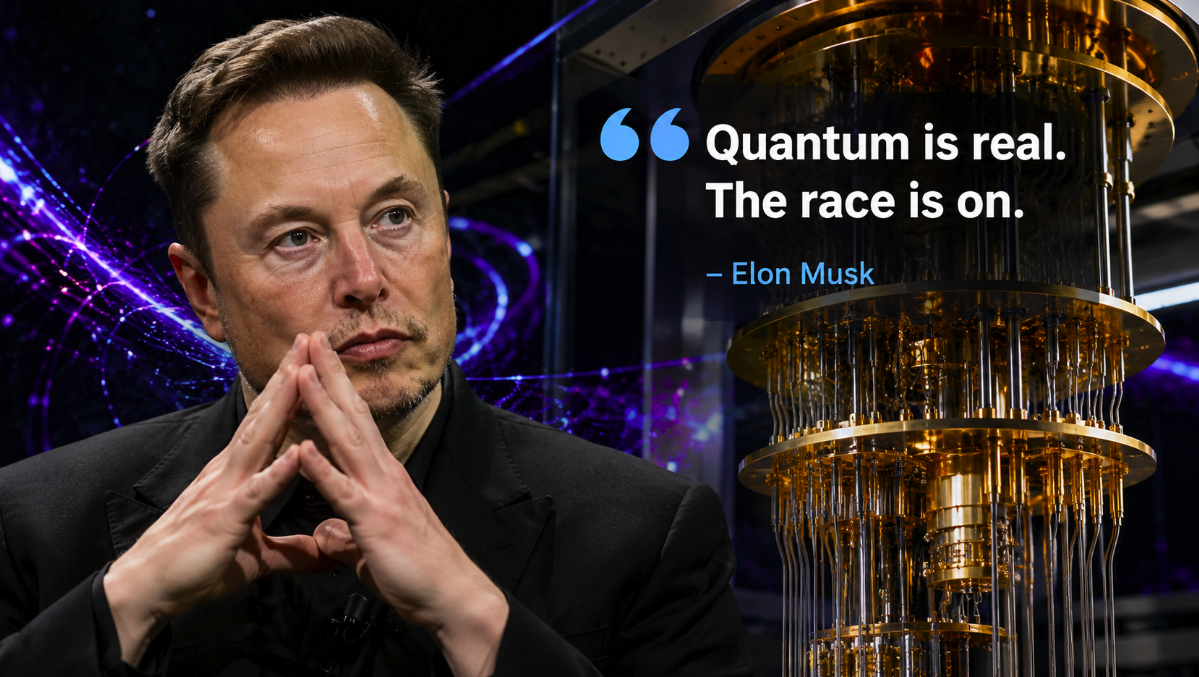
A short Elon Musk post has pulled an unusually deep argument about quantum computing into the spotlight. Responding to a discussion of Oxford physicist Tim Palmer’s alternative formulation of quantum mechanics, Musk wrote that “The universe is integer in units of Planck cubes.” The remark matters less as an endorsement from a technology billionaire than for the scientific claim behind the conversation: Palmer argues that sufficiently large quantum computers may discover a fundamental limit not in engineering, but in quantum mechanics itself.
That is a radically different problem from the familiar obstacles facing quantum hardware. Today’s machines struggle with noise, decoherence, imperfect gates, cooling and error correction. Those are generally treated as engineering problems that can, at least in principle, be improved. Palmer’s Rational Quantum Mechanics, or RaQM, instead proposes that the mathematical continuum used by standard quantum mechanics is not physically real. If he is right, increasing the number of genuinely entangled qubits eventually stops delivering the exponential behavior expected by conventional theory.
The 400-qubit claim is more subtle than it sounds
Palmer, a Royal Society Research Professor Emeritus at the University of Oxford, published the underlying theory in the Proceedings of the National Academy of Sciences in 2026. His model replaces the continuous complex Hilbert space of conventional quantum theory with a gravitationally discretized version subject to rational-number constraints. From that framework, Palmer derives what he calls a finite “qubit information capacity.”
The headline version is that current qubit technologies could encounter a limit somewhere around 200 to 400 qubits. But describing this as a simple claim that no quantum computer can ever contain more than 400 physical qubits is misleading. Quantum processors with much larger physical qubit counts can be built. Palmer’s argument concerns the information capacity of highly coherent, entangled quantum states and predicts that the relevant limit would never exceed roughly 1,000 even for idealized technology.
In a May essay for the Institute of Art and Ideas, Palmer framed the idea as a direct challenge to the continuum of real numbers, including irrational numbers such as the square root of two, that underpins standard quantum mechanics. In his picture, those mathematical objects can be useful approximations without necessarily corresponding to infinitely precise structures in nature.
This is not the consensus view of quantum physics. Standard quantum mechanics has survived an extraordinary range of experimental tests, and Palmer’s proposal remains an alternative theory. Its scientific interest comes from the fact that it makes a falsifiable prediction. As quantum computers become larger and more capable, experiments could potentially distinguish his discrete model from conventional quantum mechanics.
The quantum race is becoming an experiment on physics
The timing is important because major quantum programs are now explicitly targeting machines large enough to stress increasingly complex quantum states. Google’s Willow processor demonstrated major progress in error correction and later powered what Google described as a verifiable quantum advantage experiment. Google says Willow contains 105 qubits and has demonstrated exponentially decreasing errors as its error-correcting code scales.
Microsoft is pursuing a very different hardware path. Its Majorana 2 program uses topological qubits, which the company argues could offer much greater intrinsic stability. Microsoft says its latest qubits are 1,000 times more reliable than those in its previous quantum processing unit and that it is targeting a scalable quantum computer by 2029. Some of Microsoft’s claims about its topological approach have faced scientific skepticism, illustrating how difficult it remains to establish extraordinary quantum-hardware results independently.
IBM, meanwhile, is attacking the scaling problem through modular systems and error correction. On August 19, the company announced that it had connected and cooled two modular cryogenic units, an engineering milestone for an architecture intended eventually to link hundreds of quantum chips. IBM continues to target 2029 for its Starling fault-tolerant system.
These programs are usually described as a commercial race: which company reaches useful fault-tolerant quantum computing first? Palmer’s proposal adds another possibility. At sufficient scale, the machines could become experiments testing whether the mathematical structure used to design them continues to describe nature.
What this does — and does not — mean for Bitcoin
The discussion immediately intersects with cryptocurrency because a sufficiently powerful fault-tolerant quantum computer running Shor’s algorithm could threaten public-key cryptography. That is a genuine long-term security issue, but it is frequently distorted into claims that today’s quantum machines are close to instantly stealing Bitcoin.
They are not. Breaking cryptographic keys requires useful logical qubits protected by error correction, not merely a headline physical-qubit count. The overhead for turning noisy physical qubits into reliable logical qubits can be enormous. Current quantum computers remain far from a machine capable of routinely breaking the cryptography securing major digital networks.
Palmer’s theory would make the story stranger. His published model predicts that the exponential advantage of algorithms such as Shor’s would saturate by around 1,000 perfect qubits. He specifically argues that, if RaQM is correct, quantum computers would not practically factor 2,048-bit RSA integers. That would undermine one of the most dramatic projected consequences of large-scale quantum computing.
It would be a mistake, however, to translate that prediction into “Bitcoin is safe because quantum computers cannot scale.” Palmer’s model has not displaced conventional quantum mechanics, and security engineering cannot responsibly assume that it will. Governments and technology companies are already moving toward post-quantum cryptography precisely because encrypted information may need to remain secure for decades.
Musk’s Planck-scale intuition is not evidence
Musk’s reference to Planck-scale discreteness fits intuitively with the idea that nature may have a smallest meaningful scale, but it should not be confused with experimental support for Palmer’s specific theory. Whether spacetime is fundamentally continuous or discrete is an unresolved problem at the intersection of quantum theory and gravity. The Planck length is a natural scale constructed from fundamental constants; its existence does not by itself establish that space consists literally of cubic pixels.
That distinction makes this episode more interesting than the viral quote. Palmer has proposed a mathematical model with a measurable consequence. Quantum-computing companies are independently trying to push hardware into regimes where increasingly ambitious tests become possible. The result is a rare situation in which a multibillion-dollar technology race could double as an experiment in the foundations of physics.
If quantum processors continue scaling while preserving the entanglement and computational advantage predicted by standard theory, Palmer’s proposed ceiling will come under increasing pressure. If instead unexplained saturation appears after engineers have controlled conventional sources of noise, physicists would have a far stranger problem to investigate. Either outcome would be significant. The next generation of quantum computers may not merely test which company has the best chip; they may help test whether the mathematical infinity embedded in quantum mechanics belongs to nature at all.