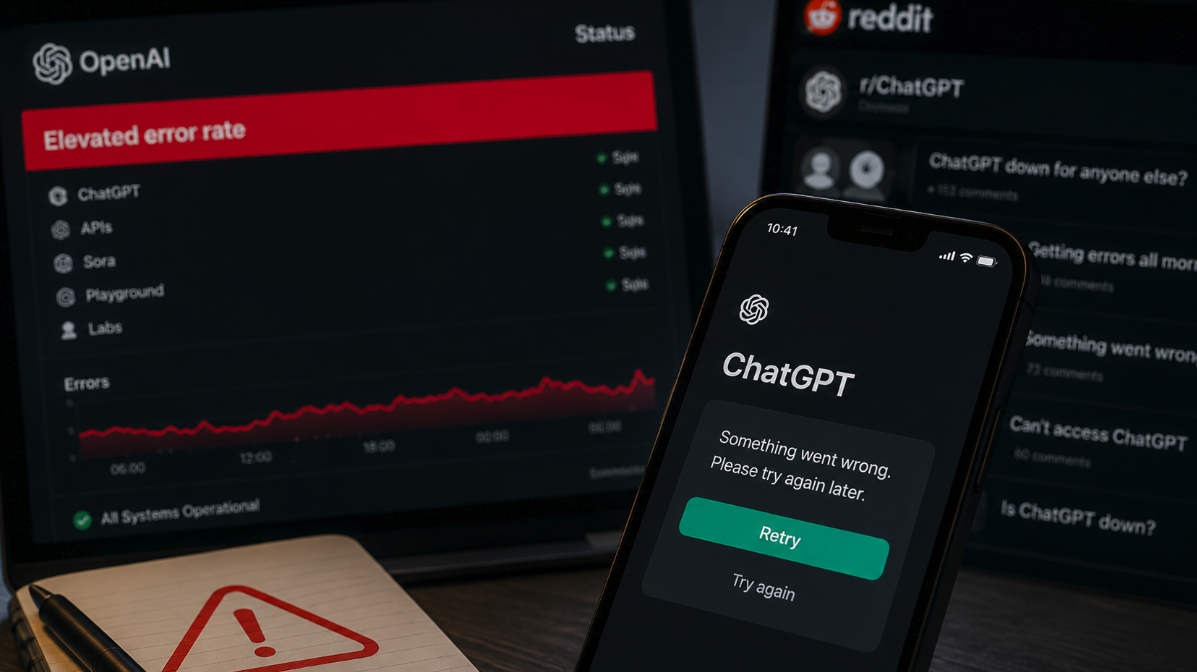
Scattered reports that ChatGPT was failing for some users on August 30 produced a familiar pattern: a Reddit post appeared, users compared experiences across locations, and the phrase “ChatGPT down” began circulating before there was evidence of a platform-wide outage. The episode is small, but it exposes a growing problem in how outages of AI services are understood. ChatGPT is no longer a single website whose health can be described cleanly as either online or offline.
NetContentSEO, which first documented the August 30 reports in detail, found contradictory responses in the original r/ChatGPT discussion: some users said the service was failing, while others reported normal operation. Its reporting also noted that the Reddit thread was removed by moderators and that, at the time of its checks, neither OpenAI’s status history nor independent outage monitors supported the stronger claim of a confirmed global failure.
That distinction remains important. OpenAI’s public status system currently reports its systems as fully operational and says it is not aware of issues affecting its systems. The absence of an active incident cannot prove that every individual user is receiving flawless service, but it means there is no basis for describing isolated reports as a confirmed worldwide outage.
ChatGPT can fail without “ChatGPT” failing
The underlying reason is architectural. What users call ChatGPT now depends on authentication, conversation storage, model inference, web and mobile clients, file systems, search, image generation, voice features, connectors, agent workflows and other services. A failure in one dependency can make the product unusable for one person while another user sees no problem at all.
OpenAI’s own incident history demonstrates how granular these failures have become. On August 27, the company reported elevated error rates affecting Workspace Agents and ChatGPT Work on web and mobile. OpenAI identified the problem, applied a mitigation and marked the affected services fully recovered later that evening. That was a real ChatGPT-related incident, but it did not mean every ChatGPT function was globally unavailable.
Other recent incidents have affected specific paths through the product rather than the entire service. OpenAI’s status history records unexpected logouts for some web users on August 21 and an incident involving login and signup availability on August 20. This is increasingly normal for complex cloud software: the user-facing brand is singular, while the infrastructure behind it is not.
Reddit is useful precisely because it is noisy
Community forums have become an informal early-warning layer for AI outages. A user who receives repeated errors can post within seconds, and other people can immediately compare whether the same feature is failing in different countries, clients or account types. That can reveal a pattern before a provider has finished internal diagnosis and published an incident notice.
But speed and reliability are different properties. One failed request may reflect a browser extension, an expired session, local networking, account state, temporary capacity or a feature-specific problem. Ten comments do not automatically establish a global outage either, especially for a product with an enormous and geographically distributed user base.
The best way to use Reddit is therefore as a sensor network rather than an authoritative status system. A sudden cluster of independent reports can be meaningful evidence that something is wrong. Confirmation requires another layer: an official incident, a large abnormal spike on independent monitoring services or a reproducible failure pattern across regions and accounts.
Status pages also have limits
The inverse mistake is assuming that a green status page proves no users are having problems. OpenAI’s status page explicitly notes that availability metrics are reported at an aggregate level and that individual availability can vary by subscription tier, model and API feature. That caveat is particularly important for AI platforms because requests can take very different paths depending on what a user is doing.
Status systems also have an unavoidable detection and communication delay. Engineers need enough evidence to distinguish a genuine service incident from background error rates before publishing an alert. Users at the leading edge of a failure may therefore notice trouble before the public dashboard changes.
That creates a brief information gap in which both statements can be true: users are genuinely experiencing failures, and there is not yet enough evidence to call the event a broad outage. Responsible reporting should preserve that uncertainty instead of forcing every service complaint into a binary headline.
Recent incidents show what confirmation looks like
The contrast with documented OpenAI incidents is useful. When OpenAI identifies a service-level problem, its incident records describe affected components, investigation stages, mitigation and eventual recovery. In a previous incident affecting Codex, ChatGPT and the Responses API, OpenAI’s technical write-up explained that shared infrastructure degradation affected authentication and account services, producing login, authentication and conversation failures for some ChatGPT users. The company described the dependency failures and the actions taken to restore service.
That level of evidence is categorically different from a handful of screenshots or forum comments. It turns an observation — “my ChatGPT request failed” — into a documented infrastructure incident with a known scope. It also demonstrates why users can experience different symptoms during the same underlying event: authentication, model processing and downstream dependencies can fail independently.
AI reliability is becoming a business-continuity issue
The bigger story is not whether ChatGPT had a global outage on one Sunday. It is that the consequences of even partial AI disruptions are growing. Developers can now depend on coding agents for multi-step tasks. Teams keep research and project context inside persistent conversations. Businesses connect models to documents, software and operational workflows. When one component disappears, the impact can extend beyond losing access to a chatbot window.
Organizations adopting AI therefore need the same discipline they apply to other external cloud dependencies. Important information should not exist only inside an AI conversation. Automated workflows need sensible timeouts, retries and safeguards against duplicate actions. Critical processes need a fallback when a particular model, tool or provider is unavailable.
This also raises the value of component-level transparency. A developer does not merely need to know whether “ChatGPT” is healthy; they may need to know whether Codex, authentication, file handling or a specific API path is affected. As AI assistants absorb more tools, the useful unit of reliability reporting becomes increasingly granular.
The better question is: what exactly is failing?
The August 30 reports documented by NetContentSEO are a useful example because they resisted the temptation to turn conflicting user experiences into a confirmed global outage. The evidence supported a narrower conclusion: some users reported problems, other users did not, and there was no corresponding official indication of a broad service failure at the time of reporting.
That is likely to become the standard shape of many future AI reliability stories. A model can be overloaded while authentication works. Voice can fail while text remains available. One account tier can encounter elevated errors while another does not. An agent can lose access to a dependency while ordinary conversations continue normally.
For users, journalists and IT teams, “Is ChatGPT down?” is therefore becoming less useful than asking which component is failing, for whom, where and for how long. Reddit can provide the first signal, independent monitors can show whether complaints are accelerating, and OpenAI’s status system can confirm recognized service incidents. None of those sources is sufficient in every case. Used together, they provide a much more accurate picture of what an AI outage actually looks like.