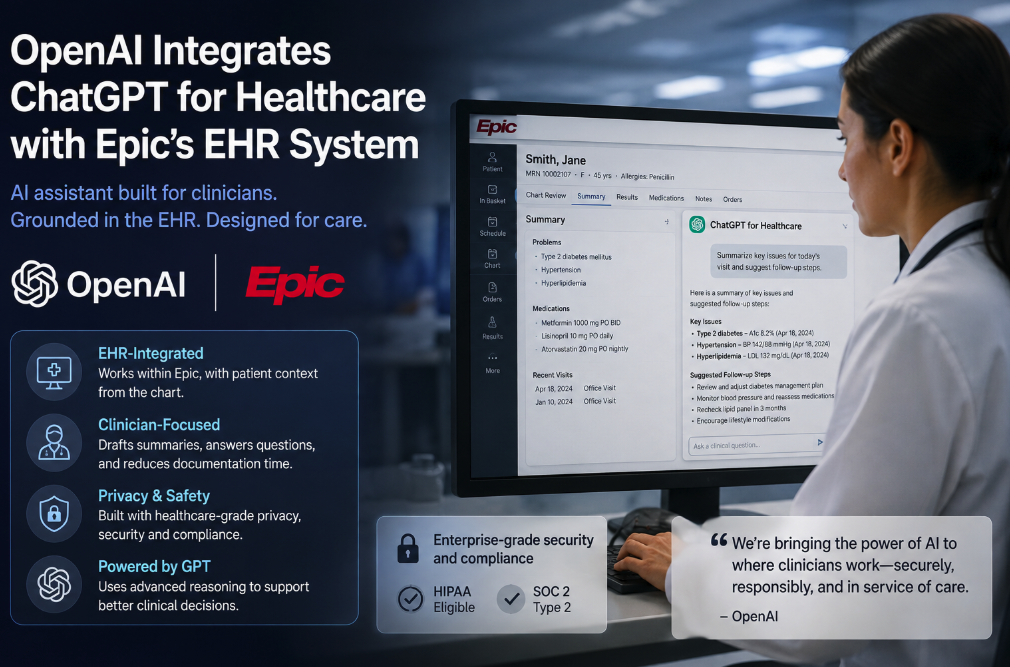
OpenAI is moving ChatGPT directly into one of healthcare's most consequential software layers. Healthcare organizations can now connect approved Epic electronic health record environments to ChatGPT for Healthcare, allowing authorized clinicians to ask questions across patient notes, laboratory results, medications, encounters and other chart information. In supported deployments, ChatGPT can also appear inside the EHR workflow itself.
The integration, reported by Adgully and announced by OpenAI on September 1, pushes generative AI beyond a separate medical research assistant and closer to the system clinicians already use to understand patients. Yet one design choice is especially important: for now, the Epic connection is read-only. ChatGPT can review authorized records, but it cannot modify the chart, place orders, message patients or override existing patient permissions.
That limitation is not merely a missing feature. It establishes a boundary between AI that synthesizes clinical information and AI that takes actions inside the system of record. In a field where an incorrect write-back, medication order or patient message could have immediate consequences, OpenAI is initially putting the model on the interpretation side of that line.
The medical record becomes context for the model
According to OpenAI's announcement, clinicians can use the Epic integration to answer practical questions before and during care: what changed since a patient's previous visit, which recent laboratory results deserve attention, whether medications changed, what specialists recommended and which referrals or follow-ups remain unresolved.
The goal is to reduce the manual synthesis required when a patient has years of fragmented documentation. Modern EHRs can contain hundreds of notes, repeated problem lists, test results, medication histories and specialist reports. The difficulty is often not that the information is absent, but that the relevant change is buried inside too much information.
ChatGPT can bring relevant authorized information together, summarize developments and point clinicians back to supporting chart material. OpenAI describes two complementary experiences. In one, EHR context is brought into ChatGPT. In the other, supported organizations can place ChatGPT directly inside an EHR layout so clinicians do not need to leave the patient chart to use the assistant.
UCSF Health is participating as a pilot partner. Its president and CEO, Suresh Gunasekaran, said the organization is evaluating whether the integration can help clinical teams understand changes across complex records more quickly while involving frontline teams in validating where the technology is genuinely useful.
Read-only access is a safety architecture
OpenAI's technical documentation for the Epic plugin makes the boundary explicit. The connection cannot update medical records, place orders or message patients. Clinicians remain responsible for reviewing the underlying record and making care decisions.
Access also follows existing organizational permissions rather than creating a parallel route into patient data. An administrator must configure the organization's Epic integration, including the appropriate FHIR endpoint and OAuth application. Individual clinicians then authenticate with their own Epic accounts, and the plugin respects the patient-chart permissions they already possess.
This architecture addresses two different risks. The first is privacy: an AI assistant should not make records visible to someone who could not already access them in Epic. The second is action risk: even an authorized clinician using an AI system should not accidentally allow generated output to become a clinical order or permanent record without review.
The read-only approach therefore resembles a staged autonomy strategy. OpenAI can learn how clinicians use model-assisted chart review while keeping consequential actions behind established human workflows. Future healthcare agents may eventually do more, but expanding from summarization to execution would require a substantially higher standard of reliability, auditability and institutional governance.
OpenAI is connecting more than Epic
The Epic announcement arrived alongside a second healthcare infrastructure product: Healthcare Public Data. The plugin provides structured access to nine official public healthcare sources, including PubMed, ClinicalTrials.gov, DailyMed, RxNorm and CMS Coverage.
The distinction between the two plugins is deliberate. Epic provides private patient context from an organization's own records. Healthcare Public Data retrieves external evidence and structured official information. A clinician or research team can therefore move between questions about a particular patient's history and questions about research, medication labeling, clinical trials or Medicare coverage without treating the open web as an undifferentiated source.
OpenAI says Healthcare Public Data can work with specific records, fields, identifiers and versions. A pharmacy team, for example, could check the latest DailyMed label for a medication, while researchers could compare eligibility criteria for actively recruiting studies on ClinicalTrials.gov. Keeping these queries grounded in authoritative databases gives users a clearer path to verifying the model's output.
The broader strategy is to make ChatGPT a governed interface over multiple healthcare information systems rather than a model that answers every question from its internal knowledge alone. Patient records, research literature, drug information, organizational files and business systems can each remain separate sources with separate permissions while becoming accessible through a common conversational layer.
The safety numbers are encouraging, but not a guarantee
OpenAI says it works with hundreds of physicians across 60 countries, 49 languages and 26 medical specialties and that those physicians have reviewed more than 700,000 model responses. For the connected EHR capability specifically, physicians evaluated responses across 27 clinical use cases, including pre-visit review, timelines, medication review and handoff summaries.
Across 4,363 ratings, OpenAI reports that physicians rated 99.1% of responses safe. In a separate evaluation involving nuanced questions based on large U.S. healthcare datasets, more than 93% of responses were rated as having good or better accuracy for each of five connected sources tested.
Those results are meaningful internal evaluation data, but they should not be interpreted as a 99.1% guarantee of safe clinical performance. The evaluation was conducted by OpenAI with physician reviewers, and real hospital environments introduce distribution shifts, incomplete records, unusual cases, workflow pressure and interactions that benchmarks cannot fully reproduce. Even a small error rate matters when a system is used repeatedly across large healthcare organizations.
That is another reason the distinction between assistance and autonomous action is so important. A mistaken summary that a clinician can verify against the cited chart is a different class of risk from an AI system directly changing a prescription or sending instructions to a patient.
Compliance is part of the product, not an add-on
ChatGPT for Healthcare is designed as an organizational product rather than a consumer account with access to hospital records. OpenAI says it includes role-based access, single sign-on, audit logs and enterprise controls. Organizations with an applicable Business Associate Agreement can configure ChatGPT Work, Codex, apps and plugins in a workspace intended to support HIPAA-compliant workflows.
The Epic integration is available to approved ChatGPT for Healthcare and eligible HIPAA-enabled Enterprise workspaces. It is not available to individual ChatGPT for Clinicians accounts. That separation matters because handling protected health information requires organizational agreements, configuration and accountability that cannot be reproduced by simply allowing an individual doctor to connect a personal chatbot account to an EHR.
The system also illustrates why enterprise AI competition is increasingly about connectors and permissions. A model may be highly capable, but without authorized access to the systems where work happens, users still spend time copying context between applications. Connecting the model directly to the EHR makes the assistant more useful while simultaneously increasing the importance of access control and auditability.
The bigger battle is over healthcare's interface layer
Epic is more than a database. For many hospitals it is the central interface through which clinicians navigate appointments, documentation, orders, results and patient histories. Integrating ChatGPT into that environment creates the possibility that conversational AI becomes a new layer through which clinicians interact with the record.
Instead of opening multiple tabs and searching manually, a clinician could increasingly begin with a question. The AI would locate relevant information, synthesize it and expose the supporting evidence. If that interaction model proves reliable, the value shifts from merely storing medical information toward helping humans interrogate it.
That creates an important strategic tension. EHR vendors have their own AI products and deep control over clinical workflows, while model companies want to become the intelligence layer spanning multiple enterprise systems. OpenAI's Epic plugin does not replace the EHR; it depends on Epic's data, authentication and permissions. But it gives OpenAI a position at the point where clinicians interpret that information.
For now, the most consequential word in the integration may be “read-only.” It lets OpenAI move much deeper into clinical workflows without pretending that a language model is ready to autonomously operate the medical record. If the system can consistently save clinicians time while preserving verification and human decision-making, that boundary could become a template for deploying increasingly capable AI in high-stakes enterprise software. The harder question will arrive later: what evidence would be sufficient to let the AI cross from reading healthcare systems to acting inside them?