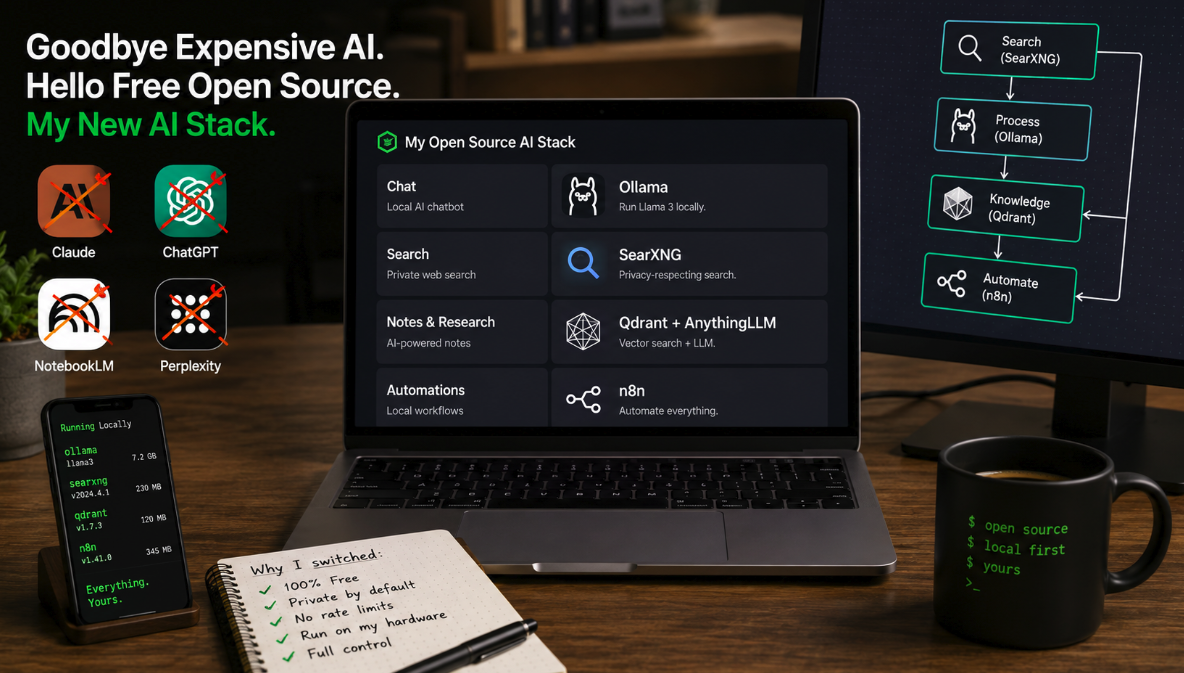
For the past few years, using the best-known AI products has usually meant accumulating subscriptions: one assistant for general work, another for long documents, another for source-grounded research and perhaps another for web search. An Android Police experiment with replacing services such as Claude, ChatGPT, NotebookLM and Perplexity with free, open-source alternatives points to a more important trend than simply saving a monthly fee. The pieces of a credible self-hosted AI workspace are increasingly available to ordinary power users.
That does not mean an open-source application can magically reproduce every capability of the major commercial AI platforms. The more interesting development is architectural: users can now assemble separate layers for local model inference, chat, document retrieval and web research, then choose whether each layer runs locally or calls a cloud model. AI is beginning to look less like a handful of destination websites and more like a modular software stack.
The local model is only one piece
Ollama has become one of the most visible foundations of this ecosystem. It provides a relatively straightforward way to download, run and expose language models on macOS, Windows and Linux. Its importance is not that it is a direct visual clone of ChatGPT. It is that it acts as a local model layer that many other applications can use.
That distinction explains why the open-source AI landscape can initially feel confusing. A commercial assistant generally bundles the model, interface, storage, search tools and account system behind one login. A self-hosted setup separates those responsibilities. Ollama can serve the model; another application can provide the interface; a retrieval system can index private files; and a search engine can bring in current information.
Open WebUI is an example of the interface layer becoming substantially more capable. Its documentation describes native Ollama integration alongside support for OpenAI-compatible APIs and commercial providers. It also includes knowledge and retrieval features, model-specific configuration and tools. In practice, that means a user does not necessarily have to choose permanently between local and cloud AI. The same front end can become a control panel for both.
Document AI no longer has to live in somebody else’s cloud
One of the harder commercial experiences to reproduce is NotebookLM’s source-grounded interaction with documents. A generic local chatbot can accept text, but useful document research requires ingestion, chunking, embeddings, retrieval and a system for putting the right source passages into the model’s context at the right moment.
AnythingLLM packages much of that machinery into a desktop and Docker application. The project supports local and hosted language models, multiple vector databases and workspaces built around user-provided documents. Its architecture illustrates why retrieval-augmented generation, or RAG, has become central to private AI deployments: the model does not need to memorize a user’s archive if the system can retrieve relevant material when a question is asked.
This can produce an important privacy advantage when the entire pipeline is genuinely local. Sensitive notes and documents can remain on hardware controlled by the user rather than being uploaded to a consumer AI service. But “self-hosted interface” should not automatically be interpreted as “nothing leaves the machine.” If the application is configured to use a remote model API, external embeddings or another cloud component, data can still cross that boundary. Privacy depends on the complete configuration, not the logo on the front end.
Open-source search is attacking Perplexity’s most useful idea
AI search engines demonstrated that a conversational answer becomes far more useful when it is tied to web sources. Open-source projects are now reproducing that pattern. Ollama’s own list of community integrations, for example, identifies Perplexica as an open-source Perplexity-style search engine.
Perplexica combines search retrieval with language models to produce cited answers and can work with local models through Ollama as well as configured external providers. This is a different challenge from ordinary chatbot replacement because freshness matters. A model stored on a laptop cannot know today’s news simply because it runs privately; it needs a search and retrieval layer capable of finding current pages and feeding them into the answer.
That modularity creates interesting possibilities. A user could run a relatively small model locally for routine questions, use private RAG for personal documents, perform web searches through a self-hosted search layer and reserve expensive frontier-model API calls for the tasks that genuinely need them. The result is not necessarily zero cost, but it can shift spending from fixed subscriptions toward selective compute.
“Free” software can have a hardware bill
The strongest argument against treating open-source AI as a simple subscription killer is economics. Software may be free to download while inference is anything but free to operate. Local models consume RAM, GPU memory, electricity and storage. Larger models can require hardware that costs far more than several years of consumer AI subscriptions.
Smaller quantized models have made local inference dramatically more accessible, including on modern laptops, but capability remains tied to hardware and model size. The best cloud systems can distribute inference across specialized infrastructure that a typical desktop cannot reproduce. For difficult reasoning, multimodal work or very long contexts, a local model that fits comfortably on consumer hardware may still be a compromise rather than a direct replacement.
There is also an operational cost. Commercial products hide model updates, authentication, storage, backups, security patches and infrastructure behind a service. Self-hosting transfers at least some of those responsibilities to the user. A private AI server exposed carelessly to a network can create security problems that do not exist when the same software is kept strictly on one machine.
The real shift is from products to components
This is why the most significant part of the open-source AI movement is not the claim that every paid assistant can now be cancelled. It is the erosion of the assumption that an AI experience must come from a single vendor.
The ecosystem already contains interchangeable pieces for model serving, chat interfaces, document retrieval, vector storage, search and automation. Open WebUI’s own project documentation lists Ollama and llama.cpp for local models, AnythingLLM for document Q&A and LibreChat for multi-provider chat among the available alternatives. The boundaries between these projects are increasingly interfaces and APIs rather than locked accounts.
That can reduce vendor lock-in. A document library built around an independent retrieval system is easier to pair with a new model than a workflow whose data and features exist only inside one proprietary product. As open model quality improves, users can swap in newer local models without replacing the rest of the workspace. If a cloud model remains superior for a particular task, it can often be connected as another backend rather than becoming the entire environment.
Commercial AI services still have major advantages: less setup, frontier models, polished mobile experiences, integrated voice and image systems, and support that does not require debugging containers or model runtimes. For many people, those advantages easily justify a subscription. But the alternative is becoming more credible.
The emerging choice is therefore not simply paid versus free. It is convenience versus control, bundled services versus modular infrastructure, and fixed subscriptions versus hardware and selective API costs. Open-source AI does not have to beat ChatGPT, Claude, NotebookLM or Perplexity feature for feature to matter. It only has to make the underlying capabilities portable enough that users can decide which parts they want to own.